SEO by HighSoftware99.com vs Traditional SEO: Key Differences
SEO by HighSoftware99.com vs Traditional SEO

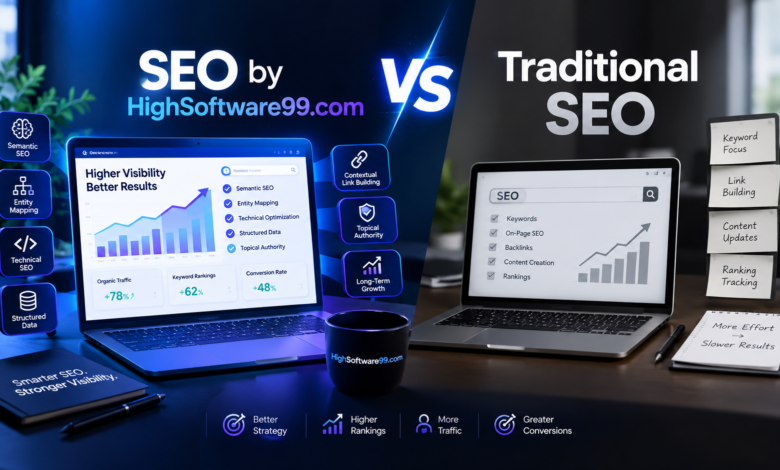
Search engine optimization has changed considerably as search engines have become better at understanding language, context, entities, and user intent. The basic objective remains the same—helping people discover useful webpages—but the methods used to pursue that objective have evolved.
SEO by HighSoftware99.com presents itself as a semantic SEO methodology that places greater emphasis on entities, topical relationships, structured content, technical performance, and contextual linking. Traditional SEO, by comparison, is a broad term covering established practices such as keyword research, on-page optimization, technical SEO, link building, and content creation.
The distinction is important because traditional SEO is not necessarily outdated. Many of its fundamentals remain part of modern search optimization. The more useful question is how a structured semantic approach changes the way those fundamentals are organized and applied.
What Is SEO by HighSoftware99.com?
According to HighSoftware99.com, its methodology is built around Semantic SEO rather than treating individual keywords as isolated targets. The approach focuses on identifying a central topic or entity, mapping related concepts and attributes, and organizing content around those relationships.
The company’s published framework describes several connected areas, including entity mapping, topical authority planning, Entity-Attribute-Value content organization, technical optimization, structured data, and contextual link acquisition. These are presented as parts of one broader optimization system rather than separate SEO tasks.
This concept is broadly consistent with an important principle in modern search: search engines do not simply count how many times a keyword appears on a page. Google says its ranking systems use many signals to understand pages and determine which results are relevant and useful for a particular query.
However, specific HighSoftware99 claims about performance should be treated as claims made by the service provider unless independently verified. A methodology can be technically sophisticated without guaranteeing particular rankings or traffic results.
What Is Traditional SEO?
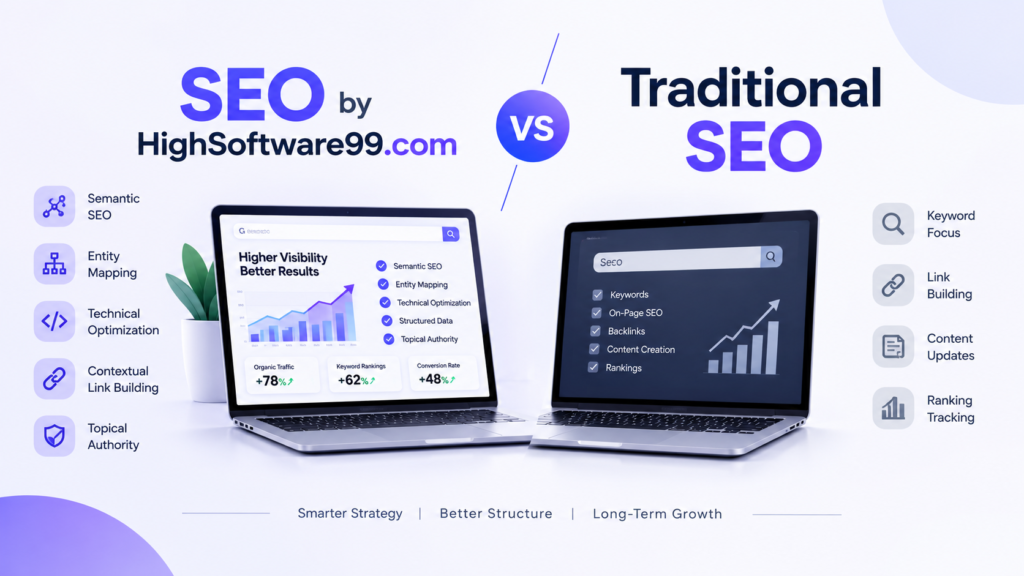
Traditional SEO is not one single technique. It generally refers to the established collection of practices used to improve a website’s visibility in organic search.
These practices can include keyword research, title and heading optimization, meta descriptions, internal linking, technical SEO, content creation, site architecture, backlinks, image optimization, mobile usability, and performance improvements.
Some older SEO tactics—such as keyword stuffing, producing thin pages, or acquiring large numbers of irrelevant links—have become less appropriate as search engines have improved. But that does not mean fundamental SEO has disappeared.
Google’s own SEO documentation still recommends making content understandable to search engines, using descriptive titles, creating crawlable links, maintaining useful content, and following technical requirements.
SEO by HighSoftware99.com vs Traditional SEO: The Main Difference
The biggest difference is how the SEO process is organized.
A conventional campaign may begin with a list of target keywords and then create or optimize pages around those terms. A semantic approach starts more broadly by identifying the main subject, related entities, attributes, questions, and relationships that collectively describe a topic.
For example, a website targeting the topic “technical SEO” might traditionally focus on keywords such as “technical SEO,” “technical SEO services,” and “technical SEO audit.”
An entity-focused approach could instead map related concepts such as crawling, indexing, canonicalization, robots.txt, XML sitemaps, JavaScript rendering, structured data, Core Web Vitals, redirects, and internal linking. The goal is not to insert every term into one article but to understand the subject comprehensively and build an appropriate content structure.
Keyword Targeting vs Entity and Topic Mapping
Keywords remain useful because they provide insight into what people search for. Google itself recommends thinking about the words users might search for when creating content. At the same time, Google notes that its language systems can understand how pages relate to queries without requiring every variation of a phrase to appear exactly on the page.
This creates an important distinction.
Traditional keyword-led SEO can treat each search phrase as a separate optimization opportunity. Semantic SEO attempts to understand the broader subject behind those searches and organize related queries around meaningful topics.
For a business selling running shoes, for example, the broader content architecture might cover shoe types, cushioning, stability, running surfaces, foot characteristics, sizing, materials, durability, and use cases. Individual keywords then become part of that larger topical structure.
Content Structure: Keywords vs Information Relationships
Traditional optimization often places considerable attention on where keywords appear. Titles, headings, introductory paragraphs, URLs, and body content can all be optimized around the target query.
HighSoftware99’s published methodology takes a different approach by describing an Entity-Attribute-Value framework. In that model, content is organized around entities, their characteristics, and relationships between concepts.
The practical benefit of this idea is that it encourages writers to ask a better question: What information does a user actually need to understand this topic?
For example, instead of writing several paragraphs repeating “technical SEO audit,” a useful article could explain what an audit checks, why crawlability matters, how indexing problems are identified, which technical elements should be reviewed, and how issues can be prioritized.
That approach also aligns with Google’s guidance favoring useful, original, comprehensive, people-first content rather than content created primarily to manipulate search rankings.
Technical SEO: A Common Foundation
Technical SEO is one area where the difference between the two approaches may be smaller than it first appears.
Traditional SEO already includes technical considerations such as crawlability, mobile compatibility, site architecture, redirects, canonical URLs, page speed, and indexing.
HighSoftware99 gives technical performance a particularly prominent role in its published framework. Its website lists targets such as TTFB below 200 milliseconds, a DOM node limit below 1,200 elements, CLS of 0.00, and LCP below 2.5 seconds. These should be understood as the company’s stated methodology targets rather than universal Google ranking requirements.
That distinction matters. Google recommends good technical performance and page experience, but meeting a particular technical benchmark does not automatically produce high rankings.
Technical SEO creates an environment in which search engines can access, render, and understand a website more effectively. It does not replace relevance, content quality, or authority.
Internal Linking and Topical Authority
Internal linking is another area where semantic SEO can provide a more deliberate framework.
In a basic SEO strategy, internal links may simply connect related articles to help users navigate a site and help search engines discover pages.
A semantic approach goes further by considering why two pages are related. For example, a guide about “keyword research” could naturally link to separate resources about search intent, keyword clustering, content mapping, and competitor analysis.
HighSoftware99 describes contextual annotation around internal links as part of its methodology. The stated objective is to provide additional context about the relationship between the source and destination pages.
This idea complements Google’s explanation that links can help its systems understand what pages are about and discover other pages on a website. PageRank and link analysis also remain part of Google’s ranking systems.
Structured Data: Helpful but Not a Ranking Shortcut
Structured data is another feature emphasized by HighSoftware99. Its framework describes the use of JSON-LD and schema types appropriate to different types of content.
Structured data can provide explicit information about the meaning and classification of webpage content. Google explains that structured data can make pages eligible for certain rich-result features when the implementation meets its requirements.
However, structured data should not be confused with a guaranteed ranking technique.
Adding Schema markup does not automatically move a page to the first position. It is better understood as a way to help search engines interpret eligible content and potentially display it in enhanced search features.
What About “SEO Instant Appear” HighSoftware99.com?
The phrase SEO Instant Appear HighSoftware99.com needs careful interpretation.
HighSoftware99’s own website uses “Instant Appear” as part of its search visibility offering, while another HighSoftware99 site promotes services related to Google autocomplete visibility.
This should not be interpreted as meaning that an SEO service can guarantee instant Google rankings.
Google explicitly states that crawling and indexing take time and depend on multiple factors. It also says there is no guarantee about when, or even whether, a particular URL will be crawled or indexed.
A technically clean page can be easier for search engines to process, and submitting a sitemap or requesting crawling can help Google discover updated URLs. But indexing and ranking remain controlled by Google’s systems.
A Practical Comparison
| Area | Traditional SEO | SEO by HighSoftware99 |
| Keyword strategy | Target specific search terms | Organize keywords around entities and topics |
| Content planning | Often keyword/page focused | Topical and entity-focused |
| Content structure | Headings, keywords, readable sections | Entity relationships and information architecture |
| Technical SEO | Crawlability, speed, indexing, mobile SEO | Strong emphasis on measurable technical standards |
| Internal links | Navigation and contextual relevance | Contextual relationships between topical entities |
| Structured data | Used where appropriate | Treated as part of the semantic framework |
| Link building | Relevance and authority vary by strategy | HighSoftware99 emphasizes contextual relevance |
| Ranking expectations | Depends on competition and many signals | No legitimate methodology can guarantee rankings |
The comparison shows that the two approaches overlap significantly. The major distinction is not that one uses SEO and the other does not. Instead, HighSoftware99 packages familiar SEO disciplines into a more explicitly semantic and entity-oriented framework.
Which Approach Is Better?
There is no universal answer.
A small website with a limited number of services may achieve substantial improvements through conventional SEO fundamentals: fixing indexing problems, improving titles, creating useful content, strengthening internal links, and earning relevant mentions or links.
A larger website with hundreds or thousands of pages may benefit more from a structured topical architecture. Entity mapping can help identify content gaps, prevent unnecessary duplication, and organize relationships between pages.
The most important point is that a semantic framework should improve the quality of the SEO process rather than become a collection of complicated terminology.
A website does not need an elaborate entity map if its biggest problem is that important pages are blocked from crawling. Likewise, technical optimization cannot compensate for content that does not satisfy the searcher’s needs.
What Modern SEO Should Actually Prioritize
Regardless of whether a business follows HighSoftware99’s methodology or a more conventional SEO strategy, several fundamentals remain important.
1. Create Helpful Content
Content should answer the user’s actual question clearly and provide enough useful information to accomplish the intended task. Google specifically recommends original, reliable, people-first content and warns against creating material primarily to attract search-engine traffic.
2. Build Logical Site Architecture
Important pages should be accessible through crawlable internal links. Categories, hubs, supporting articles, and related resources should have a logical relationship rather than being published as isolated pieces.
3. Fix Technical Problems
Check indexing, robots.txt, canonical URLs, redirects, mobile usability, JavaScript rendering, page performance, and other technical issues that can prevent search engines from accessing or understanding content.
4. Match Search Intent
A keyword alone does not tell the entire story. Determine whether the searcher wants an explanation, comparison, product, service, tutorial, review, or another type of result.
5. Measure Real Outcomes
Monitor impressions, clicks, rankings, indexed pages, conversions, engagement, and other business-relevant outcomes. Search Console can help website owners understand how their pages perform in Google Search.
Final Verdict
The difference between SEO by HighSoftware99.com and traditional SEO is best understood as a difference in methodology and emphasis rather than two completely separate forms of optimization.
Traditional SEO provides the essential foundation: keyword research, useful content, technical health, internal linking, site architecture, and authority development. HighSoftware99’s published approach reorganizes many of these practices around semantic relationships, entities, topical maps, structured data, and defined technical targets.
The semantic approach can be useful when it leads to better content planning and a more coherent website structure. However, terms such as “instant appear” should not be interpreted as guarantees of instant rankings or indexing.
Ultimately, Google remains responsible for deciding which pages appear for a query. Its own documentation makes clear that rankings depend on many systems and signals, and that following SEO best practices does not guarantee crawling, indexing, or specific search positions.
For website owners, the strongest strategy is therefore not to choose complexity over simplicity. It is to combine sound technical SEO with useful, original content, logical topical organization, relevant internal linking, appropriate structured data, and a clear understanding of search intent.
FAQs
Is SEO by HighSoftware99.com different from traditional SEO?
Yes, primarily in methodology. HighSoftware99 describes its approach as semantic and entity-focused, with greater emphasis on topical mapping, contextual relationships, technical standards, structured data, and contextual links. Many of these individual practices also exist within modern traditional SEO.
Can SEO by HighSoftware99.com guarantee first-page rankings?
No SEO provider can legitimately guarantee a specific Google ranking. Google uses many automated systems and signals, and rankings depend on factors including relevance, competition, content quality, and the overall search environment.
Does “SEO Instant Appear” mean instant Google rankings?
No. The phrase should not be interpreted as a guarantee of instant rankings. Google states that crawling and indexing can take time and cannot be guaranteed for individual URLs.
Is traditional SEO still useful?
Yes. Keyword research, technical SEO, internal linking, useful content, site architecture, and relevant authority signals remain important. Modern SEO has evolved rather than abandoned these fundamentals.
Which approach should a website choose?
The best approach depends on the website’s problems, size, competition, and goals. Smaller sites may need strong SEO fundamentals first, while larger sites can benefit from more systematic topical and entity-based planning.
