Receiving an RLP letter can be worrying, especially if you have never heard of Retail Loss Prevention Limited before. These letters are commonly associated with alleged shoplifting or other incidents at retail stores, and they may request payment for costs that a retailer claims to have incurred.
However, receiving a demand for money does not mean that a court has found you guilty or ordered you to pay. An RLP letter is generally part of a civil recovery process, which is separate from criminal proceedings.
Understanding what the letter means, what the retailer is claiming, and what options you have can help you make a more informed decision. This guide explains how RLP letters work in the UK, whether you must pay, what happens if you do not respond, and where to seek independent advice.
What Is an RLP Letter?
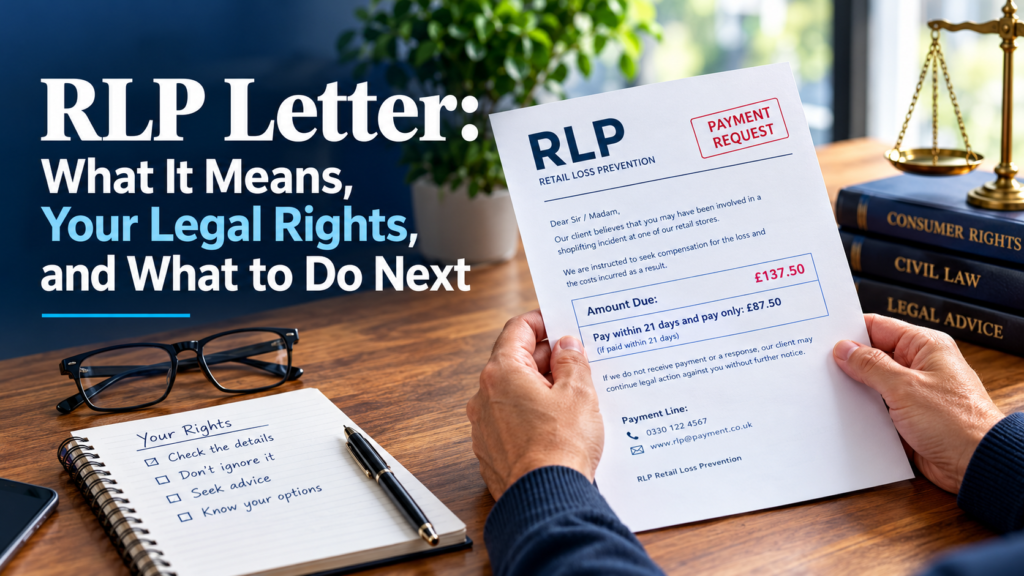
An RLP letter is a civil recovery demand usually sent by Retail Loss Prevention Limited on behalf of a retailer. It may follow an allegation of shoplifting, theft, employee dishonesty, or another incident that a business believes caused it a financial loss.
Retail Loss Prevention Limited is a private company, not a government department or a court. Its role in this context is to manage civil recovery claims for retailers and contact individuals about the money the retailer says it is owed.
The purpose of the letter is to request compensation for alleged losses or expenses connected with an incident. The amount requested may include costs beyond the retail price of the goods involved.
An RLP letter is not a criminal conviction, a police fine, or a court judgment. It is a demand based on a claim made on behalf of a retailer. Whether the amount is legally recoverable depends on the circumstances and the applicable law.
Citizens Advice confirms that businesses may seek civil compensation for alleged theft-related losses, including through companies such as Retail Loss Prevention. Civil action can occur independently of criminal proceedings or alongside them.
| 🔗 You may also like: |
| Cnlawblog |
| Statens Luftfartsvaesen |
Why Do People Receive an RLP Letter?
A retailer may refer an incident to RLP when it believes someone has caused a financial loss or is responsible for an incident on its premises.
Common situations can include:
- Alleged shoplifting or attempted theft.
- Suspected theft by an employee.
- Alleged fraud involving refunds or transactions.
- Damage to retail goods.
- Other incidents in which a retailer claims to have incurred recoverable losses.
For example, a store might stop a customer over suspected shoplifting, recover the goods, and subsequently send the customer’s details to a civil recovery company. The individual may then receive a letter requesting payment for costs associated with handling the incident.
A letter may arrive even if the goods were recovered or the police were not involved. Recovering the goods does not automatically prevent a retailer from pursuing compensation for other losses it can legally establish.
However, the existence of an allegation does not establish that every claimed cost is justified. The facts, available evidence, and legal basis for the demand remain important.
What Information Does an RLP Letter Contain?
Although the format can vary, an RLP letter may include several details to identify the claim and explain what the retailer wants.
These may include:
- The name of the retailer.
- The date and location of the alleged incident.
- A description of what supposedly happened.
- A case or reference number.
- The amount being claimed.
- An explanation of the costs or losses.
- Instructions for responding or making payment.
- A deadline and information about possible further action.
Read the entire letter carefully rather than focusing only on the payment amount. Check whether the incident details are accurate, whether the claim explains how the amount was calculated, and whether the sender has provided a way to contact them.
Keep the original letter and any accompanying documents. If something appears incorrect, make a note of the discrepancy and preserve any evidence that could help clarify the situation.
A private demand letter should also be distinguished from official court documents. If you receive a formal court claim, follow the instructions and deadlines stated in those documents.
Do You Have to Pay an RLP Letter?
Receiving an RLP letter does not automatically mean you must pay the full amount requested immediately. The letter is a civil demand, not a court order.
Nevertheless, it would be misleading to assume that every RLP claim is invalid or that no recipient ever has a legal obligation to compensate a retailer. A business can pursue a civil claim where it believes there is a legal basis for recovery.
If the matter is disputed, the relevant questions may include whether the individual is legally responsible, what loss the retailer actually suffered, whether the claimed costs are recoverable, and what evidence supports the amount.
A court can assess these issues if proceedings are brought. The outcome depends on the facts and applicable law, not simply on whether a letter has been sent.
You may decide to pay, dispute the claim, request further information, explore a settlement, or obtain independent advice. The appropriate choice depends on your circumstances and the evidence available.
Before making payment or accepting responsibility, make sure you understand what is being claimed and what any proposed settlement would cover.
How Are RLP Payment Demands Calculated?
An RLP demand may seek more than the value of the goods involved. The retailer may argue that the incident also caused expenses associated with investigating or handling it.
Depending on the claim, the listed costs might include:
- Staff time spent dealing with the incident.
- Administrative work.
- Investigation-related expenses.
- Security-related costs.
- The value of goods that were lost or damaged.
For example, a retailer might argue that its staff had to investigate an incident, complete paperwork, review evidence, and undertake additional work. It may include some of these expenses in its demand.
However, listing a cost does not automatically establish that the recipient is legally required to pay it. The retailer’s ability to recover a particular expense depends on the legal basis of the claim and the supporting evidence.
There is no single amount that applies to every RLP letter. Figures discussed in older reports or online forums should not be treated as a guaranteed current fee or as proof that a particular demand is reasonable.
If the amount seems excessive or unclear, you can seek advice about whether the claim is properly explained and legally supported.
| 🔗 You may also like: |
| Syrenis Strategic Initiatives |
| Research Dossier for Target Company |
What Are Your Options After Receiving an RLP Letter?
There is no single response that suits every case. Your options depend on whether you accept the allegation, dispute the amount, or need more information.
1. Review the Claim
Start by checking the letter against your recollection of the incident and any available records. Look at the alleged date, location, description of events, and amount requested.
If you believe the information is inaccurate, record the specific points that concern you. Keep receipts, emails, photographs, or other relevant evidence where available.
2. Ask for Further Information
If the letter does not clearly explain the claim, you may wish to request clarification about the legal basis of the demand and how the amount was calculated.
Keep your communication factual and retain copies of everything you send or receive. If you are unsure whether to provide a detailed account, consider obtaining legal advice before responding.
3. Dispute the Claim
If you believe you are not responsible or that the amount is not justified, you can dispute the claim.
Explain the grounds for your dispute clearly and avoid making statements that you cannot support. You do not need to exaggerate, speculate, or invent details to challenge a demand.
If formal court proceedings begin, make sure you follow the court’s response procedure rather than relying solely on earlier correspondence with RLP.
4. Consider a Settlement
Some recipients may wish to explore a settlement to resolve the dispute. Depending on the circumstances, this could involve discussing the amount, payment arrangements, or the terms on which the matter would be concluded.
Before agreeing, understand whether the proposal settles the entire claim and whether it requires an admission of liability. If you dispute responsibility, independent advice can help you consider the implications of a settlement offer.
5. Pay the Amount Requested
You may choose to pay if you accept the claim and want to resolve it. However, consider the terms and implications before doing so.
Confirm that the payment details are genuine and obtain written confirmation of what the payment settles. Do not assume that paying a demand will remove or resolve a separate criminal matter, if one exists.
What Happens If You Ignore an RLP Letter?
Ignoring an RLP letter does not automatically lead to arrest, a criminal record, or court action. However, it also does not guarantee that the matter will end.
You may receive further letters requesting payment. The retailer may also decide to pursue a civil claim through the courts.
Citizens Advice explains that a business can take civil legal action to recover losses associated with an allegation of theft. Whether a particular claim proceeds depends on the circumstances and the claimant’s decision.
For this reason, it is sensible to understand the letter and its deadlines rather than assuming that it can safely be ignored.
The most important distinction is between correspondence from a private recovery company and formal court papers. If a court claim arrives, do not treat it as another routine demand letter.
In England and Wales, failing to respond to a court claim can result in a judgment being entered without a full hearing in some circumstances. GOV.UK explains that a County Court Judgment (CCJ) can have consequences for a person’s credit record.
Can RLP Take You to Court?
A retailer can pursue civil court action if it considers that it has a valid claim. An RLP letter alone does not mean that proceedings have already started.
If a claim reaches court, the claimant must present its case and supporting evidence. The person responding to the claim can also put forward a defence in accordance with the applicable procedure.
The court may consider the circumstances of the incident, the alleged loss, the legal basis for compensation, and whether the amount claimed is justified.
Online discussions sometimes suggest that RLP never takes cases to court. That is too broad a statement to rely on. Although experiences reported in forums may provide background, they do not guarantee what will happen in an individual case.
If you receive a formal claim, obtain advice promptly and follow the stated court deadlines. The correct approach may differ depending on whether proceedings are in England, Wales, Scotland, or Northern Ireland.
Can an RLP Letter Affect Your Criminal Record?
An RLP letter by itself is not a criminal conviction. It is generally connected with a civil recovery claim, rather than a criminal sentence or penalty.
However, a civil demand does not determine whether a separate criminal investigation exists. A retailer may pursue civil compensation independently of criminal proceedings, and both processes can sometimes arise from the same incident.
If the police have contacted you, you have been charged, or you have received criminal court documents, treat that as a separate matter and seek appropriate legal advice.
Do not assume that paying RLP will end a criminal investigation or that receiving an RLP letter means you have been convicted.
Can an RLP Letter Affect Your Credit Score?
An RLP letter is not itself a County Court Judgment. Receiving the demand alone does not mean that a CCJ has been entered against you.
The situation may change if a civil claim proceeds to court and a judgment is made against you. In England and Wales, CCJs can be recorded on the Register of Judgments, Orders and Fines and may affect applications for credit.
GOV.UK explains that a judgment generally remains on the register for six years unless the relevant rules for removal apply. If the full judgment amount is paid within one month, the debtor can apply to have the entry removed. If it is paid later, it can generally be marked as satisfied while remaining on the register for the six-year period.
These rules relate to court judgments, not simply to receiving an RLP letter.
If you are worried about your credit record, check whether any actual court judgment exists rather than assuming that the demand itself has damaged your credit history.
What If the RLP Letter Is Addressed to Someone Under 18?
If the recipient was under 18 when the incident occurred, it is particularly important to obtain advice before accepting liability or agreeing to payment.
The legal position can depend on the person’s age, the circumstances, and the jurisdiction. Do not assume that a parent or guardian automatically becomes responsible for the amount claimed.
A parent, guardian, or trusted adult can help review the letter and preserve relevant documents. Citizens Advice or a qualified solicitor can explain the options based on the individual circumstances.
If court papers have arrived, make sure the response deadlines are not missed while seeking advice.
How to Check Whether an RLP Letter Is Genuine
Before making a payment or sharing personal information, check the sender and the details of the claim.
Confirm the company name, reference number, retailer, incident date, and contact details. If something appears suspicious or inconsistent, verify the contact information independently rather than relying only on the details in the letter.
Be cautious about unexpected requests for passwords, banking credentials, or unnecessary identity documents. Keep a copy of the letter and any communications for your records.
A professional-looking design does not, by itself, prove that a demand is genuine. Likewise, a genuine-looking demand should still be checked for accuracy and legal justification.
Where Can You Get Independent Advice?
If you are uncertain about your rights or how to respond, consider speaking with an independent advice service or a solicitor.
Citizens Advice provides information about businesses taking legal action to recover losses connected with alleged theft. Its guidance can help you understand the distinction between a civil claim and a criminal case.
A solicitor may be particularly helpful if the claim involves disputed facts, a substantial amount of money, alleged employee theft, or formal court proceedings. Advice should be based on your own documents and circumstances, not only on other people’s experiences online.
Common Myths About RLP Letters
Several misconceptions can make these letters more stressful than necessary.
Myth 1: An RLP letter is a police fine.
No. It is generally a civil recovery demand made on behalf of a retailer.
Myth 2: Receiving the letter means you have been found guilty.
No. A private demand is not a criminal conviction or a court judgment.
Myth 3: You must pay immediately because the letter looks official.
Not automatically. Understand the claim, the amount requested, and your options before deciding how to respond.
Myth 4: Ignoring the letter can never have consequences.
Incorrect. Further correspondence and civil court action are possible, even though neither is automatic.
Myth 5: Returning the goods means a retailer can never make a claim.
Not necessarily. A retailer may still seek compensation for other legally recoverable losses, depending on the facts.
| 🔗 You may also like: |
| Bilieter Explained |
| Harouxinn Explained |
Conclusion
An RLP letter is generally a civil recovery demand sent by Retail Loss Prevention Limited on behalf of a retailer following an alleged incident involving theft or another loss. It is not automatically a criminal fine, a conviction, or a court judgment.
The amount requested should be considered in light of the circumstances, the alleged loss, and the legal basis for recovery. You may be able to dispute the claim, ask for further information, consider a settlement, or seek independent advice.
If you receive an RLP letter, read it carefully, preserve your records, and understand the difference between a private payment demand and formal court papers. Above all, do not assume that you must pay simply because a letter has arrived, but do not assume that the matter can never progress to court either.
Taking time to understand your options and obtaining suitable advice can help you make a more informed decision about what to do next.
FAQs
What does RLP stand for?
RLP stands for Retail Loss Prevention in this context. Retail Loss Prevention Limited is a private company that handles civil recovery claims for retailers.
Do I legally have to pay an RLP letter?
Not simply because the letter has arrived. Whether money is legally recoverable depends on the facts, the legal basis of the claim, and any court decision that may follow.
What happens if I do not respond?
You may receive further payment demands, and the retailer may consider civil proceedings. If formal court documents arrive, follow the instructions and deadlines provided.
Can RLP give me a criminal record?
An RLP letter alone does not create a criminal conviction. A separate criminal matter, if one exists, must be considered independently.
Can an RLP letter affect my credit score?
The letter itself is not a CCJ. A later court judgment may affect your credit record, subject to the applicable rules.
Can I dispute an RLP payment demand?
Yes. If you disagree with the allegation or the amount claimed, you can challenge it and explain your reasons. Consider independent advice if you are unsure how to respond.
What should I do if I receive an RLP letter as a minor?
Ask a parent, guardian, or trusted adult to help you review the letter, and seek independent legal guidance before admitting liability or agreeing to payment.