
Understanding Test.com pricing enterprise plans is important for businesses that want to create, deliver, and manage online assessments, professional examinations, employee training tests, or certification programs. Choosing an enterprise testing platform involves more than comparing subscription prices. Organizations also need to consider hosting, initial setup, customization, administration, scalability, support, and long-term operating costs.
Test.com is associated with online testing and assessment solutions that help organizations move testing processes into a digital environment. Depending on the organization’s requirements, these solutions may support activities such as creating assessments, managing test-takers, delivering exams, and reviewing results.
One of the most important questions for prospective customers is how much an enterprise implementation will cost during the first year and in subsequent years. Published pricing figures referenced in recent online discussions indicate a starting software subscription of $10,000 per year, $1,000 per year for hosting, and a one-time setup fee of $2,000. Based on those figures, the estimated first-year starting cost is $13,000.
These amounts should be treated as published starting figures rather than guaranteed prices for every customer. Actual pricing, included services, and additional charges should be confirmed directly with the provider before making a purchasing decision.
This guide explains enterprise pricing, potential features, setup expenses, budgeting considerations, and questions businesses should ask before choosing a plan.
What Is Test.com?
Test.com is an online testing and assessment platform designed to help organizations manage testing activities digitally. Businesses and institutions that conduct recurring examinations may benefit from a centralized system for organizing assessments and handling test-related information.
Traditional testing methods can require considerable administrative effort. Paper-based exams involve printing, distributing, collecting, and storing materials. Even organizations that already use digital documents may need a more structured system to manage participants, standardize assessments, and organize results.
An online testing solution can help bring these activities into a consistent workflow. Depending on the selected package and configuration, an organization may be able to manage test content, administer assessments, and access results through a digital platform.
Potential use cases include employee knowledge assessments, training evaluations, professional certification, educational testing, and internal competency checks. The precise suitability of Test.com depends on its current capabilities and whether those capabilities match the organization’s requirements.
Enterprise customers should evaluate the platform in the context of their actual operations rather than assuming every feature is included in the starting subscription.
You may also like:
Coyyn: Digital Finance and Innovation
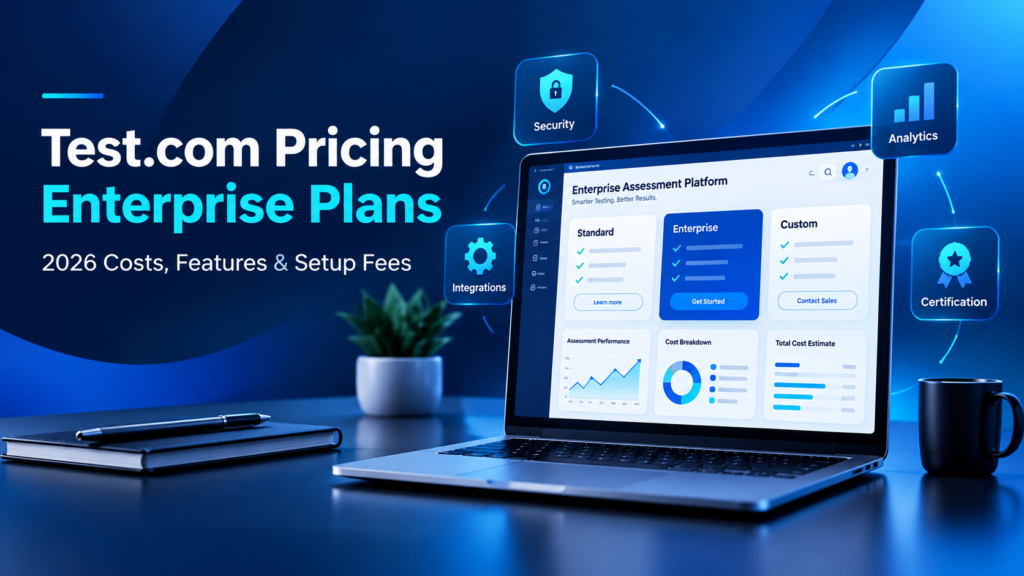
Test.com Pricing Enterprise Plans in 2026
When evaluating Test.com pricing enterprise plans, it is helpful to separate the software subscription from hosting, setup, and usage-related expenses. This makes the pricing structure easier to understand and helps businesses prepare a realistic budget.
Recent published pricing information identifies Enterprise software starting at $10,000 annually, with hosting and setup charged separately. These figures provide a starting point for financial planning, but they should be verified with the provider.
| Pricing component | Published starting amount |
| Enterprise software | $10,000 per year |
| Annual hosting | $1,000 per year |
| One-time setup | $2,000 |
| Estimated first-year total | $13,000 |
| Estimated recurring software and hosting | $11,000 per year |
These amounts are not necessarily the complete cost of operating a testing program. The actual price may depend on the services included in the customer’s agreement, assessment volume, and additional requirements.
Businesses should confirm whether usage-based fees are included in the quoted subscription or calculated separately. This distinction can significantly affect the total cost of operating a large testing program.
Understanding the $13,000 First-Year Cost
The estimated first-year cost is calculated by adding the three published starting amounts:
- Software subscription: $10,000
- Hosting: $1,000
- Initial setup: $2,000
The resulting total is $13,000.
This calculation helps prospective customers understand why the software subscription alone may not represent the complete initial investment.
For subsequent years, the same starting software and hosting amounts would total $11,000 if the rates remain unchanged and the setup fee does not recur. This is a mathematical estimate rather than a guaranteed renewal price.
For a more accurate financial forecast, organizations should request a written quotation that identifies recurring fees, one-time charges, usage-based pricing, and renewal conditions.
What Features Can Businesses Expect From Test.com Enterprise Plans?
Enterprise assessment software is generally designed to support more demanding testing requirements than a basic quiz application. Organizations should evaluate the available features against their actual operational needs before purchasing a plan.
Online Exam Creation and Management
Creating and managing assessments is a central requirement for any digital testing platform. Organizations may need to prepare question banks, develop different examinations, organize test content, and update assessments when requirements change.
A centralized assessment system can make these tasks easier to manage than separate documents or manually maintained files.
For example, a professional training organization might maintain different examinations for entry-level employees, experienced workers, and advanced certification candidates. Structured exam management helps administrators organize these assessments and maintain consistent testing procedures.
Before purchasing an Enterprise plan, businesses should verify the supported question formats, exam customization options, content migration process, and limits on assessment creation.
Candidate and User Management
Organizations conducting large numbers of examinations need an efficient way to manage participants. This may involve registering candidates, maintaining user information, assigning examinations, and tracking participation.
A centralized system can reduce administrative duplication and make it easier for staff to manage recurring assessment programs.
Companies should ask whether their proposed plan supports the required user roles, administrative permissions, bulk registration options, and integration with existing databases.
These details matter particularly when several departments or regional offices participate in the same testing program.
| You may also like: |
|---|
| Guru Knowledge Base Software |
| Growth Navigate Funding |
Reporting and Results
Assessment results help organizations understand candidate performance and identify areas that need improvement. Depending on the platform’s available reporting capabilities, administrators may be able to review examination outcomes and monitor assessment activity.
A company running employee training assessments, for example, may use results to identify knowledge gaps and determine whether additional training is necessary.
Certification organizations may need records that help them review candidate performance and manage credentialing processes.
Before committing to a plan, confirm which reports are available, whether reports can be exported, and whether the platform supports the organization’s required reporting formats.
Certification and Digital Credentials
Some testing programs require more than an examination score. They also need a process for issuing and managing professional credentials.
Certification and badging capabilities can be particularly useful to professional associations, training providers, and organizations that assess whether individuals meet specific competency requirements.
Businesses should verify how credentials are issued, whether expiration and renewal workflows are supported, and whether additional fees apply to particular credentialing features.
Integrations and Developer Tools
Enterprise organizations frequently use multiple business applications. Their assessment platform may need to exchange information with existing systems rather than operate independently.
Integration capabilities can help technical teams connect testing workflows with other applications, subject to the available interfaces and implementation requirements.
Before purchasing, ask whether the integrations you need are included in the quoted plan. Also clarify whether implementation assistance, custom development, or third-party services would create additional expenses.
Test.com Enterprise Setup Fees Explained
The setup fee is an important part of the initial cost because it increases the amount payable during the first year.
The published Enterprise starting figure is $2,000 for one-time setup. However, the exact work covered by this charge should be confirmed with the provider. Organizations should not assume that every migration, customization, or integration task is included simply because a setup fee appears in the pricing structure.
Initial Account Configuration
A testing program may require administrator accounts, user roles, assessment settings, and other configuration decisions before it is ready for use.
The implementation process should establish how the platform will support the organization’s intended workflow.
Ask which configuration activities are included in the initial fee and whether additional assistance is billed separately.
Data Migration
Businesses switching from another platform may need to transfer existing users, question banks, examination records, or other relevant information.
The complexity of migration depends on the quantity of information, its format, and the structure of the previous system.
Before signing an agreement, clarify which data can be imported, whether historical results can be transferred, and whether data cleanup or conversion services cost extra.
Staff Training and Launch
Administrators and other employees may need guidance before the new system becomes part of their daily work.
A smooth launch depends on clear instructions, appropriate access permissions, and a reliable process for handling operational questions.
Ask whether staff training, onboarding sessions, documentation, and launch support are included in the quoted implementation package.
Are There Additional Costs Beyond Enterprise Pricing?
The published starting figures do not necessarily represent every expense a business may encounter.
The most useful approach is to identify potential additional costs before signing a contract. Not every item below will apply to every customer, and these expenses should not be described as mandatory without confirmation.
Usage-Based Assessment Fees
High-volume testing programs may be subject to pricing based on the number of examinations delivered.
Some published descriptions of Enterprise pricing reference volume rates starting at $3 per test, with lower rates at higher volumes. Customers should confirm the current rate and its relationship to the annual subscription.
For example, 12,000 examinations multiplied by $3 would equal $36,000 if every examination were charged at that rate. This is only an illustrative calculation, not a prediction of the customer’s final bill.
The provider should explain whether the per-test rate applies in addition to the annual subscription, how volume tiers work, and whether minimum commitments or usage thresholds apply.
Proctoring and Examination Security
Some organizations require remote supervision or additional examination controls to protect assessment integrity.
Proctoring arrangements can involve separate services or session-based charges. The availability and cost of these services should be confirmed for the proposed configuration.
Businesses should ask which security options are included, which require additional purchases, and whether third-party providers charge separate fees.
Integrations and Customization
An organization may need a connection to its learning management system, customer database, human resources software, or another internal application.
Standard integrations may be different from custom development work. Additional engineering, testing, or implementation assistance can affect the overall project budget.
Request an itemized estimate for any integration that is essential to your operations.
Payment Processing and Other Services
Organizations that sell examinations, training programs, or credentials may need payment-processing capabilities.
If payments are collected through third-party services, transaction fees and other provider charges may apply. Their applicability depends on the selected payment arrangements and commercial terms.
Businesses should also review any charges for optional modules, additional services, or support arrangements beyond the standard package.
How to Calculate Your Total Enterprise Budget
A useful enterprise budget includes both initial implementation and recurring operations.
Start with the published software subscription, annual hosting, and setup figures. Then add only those additional expenses that apply to your requirements and have been confirmed by the provider.
| Budget category | What to confirm |
| Software | Annual subscription and renewal rate |
| Hosting | Recurring charge and included services |
| Setup | One-time implementation fee |
| Exam usage | Volume thresholds and per-test charges |
| Proctoring | Session fees and service requirements |
| Integrations | Standard access versus custom development |
| Support | Included assistance and optional service levels |
| Renewal | Price changes, contract terms, and cancellation rules |
This approach is more reliable than choosing a platform based only on its headline subscription price.
First-Year Budget
The first-year budget should account for the initial setup fee as well as recurring subscription and hosting charges.
Using the reported starting figures, the basic estimate is $13,000 before any additional applicable expenses.
An organization with a complex migration or high examination volume may need a larger budget. A written proposal should make those differences clear.
Long-Term Budget
Businesses should evaluate the total cost over multiple years rather than focusing only on the launch period.
Using unchanged starting rates, a hypothetical three-year calculation would be:
- Year one: $13,000
- Year two: $11,000
- Year three: $11,000
- Three-year total: $35,000
This calculation assumes the setup fee is charged only once and that software and hosting prices remain unchanged. It excludes usage-based charges and other potential expenses, so it is not a guaranteed three-year contract value.
Requesting a multi-year cost projection can help decision-makers compare alternatives and plan future spending.
Who Should Consider Test.com Enterprise Plans?
The Enterprise option is most relevant to organizations with substantial assessment requirements, particularly those operating formal testing or certification programs.
Certification Bodies
Professional associations and credentialing organizations may conduct examinations regularly and need structured ways to manage assessments and credentials.
An enterprise platform may help centralize these workflows, especially when multiple examinations or candidate groups are involved.
Corporate Training Departments
Large companies may use assessments to evaluate employee knowledge, training outcomes, and professional competencies.
A digital testing platform can help standardize assessments across departments and locations, provided its functionality matches the organization’s requirements.
Training Providers
Training companies may need to assess learners, manage examinations, and connect testing activities with their existing educational services.
The suitability of Enterprise depends on the number of assessments, reporting needs, and integration requirements.
Organizations With High Testing Volumes
A business that delivers many examinations each year may benefit from evaluating a platform designed for larger programs.
However, high volume alone does not automatically make Enterprise the best choice. Organizations should compare the total quoted cost with the capabilities they actually need.
Smaller programs may find that a lower-priced plan or a simpler tool provides better value.
How to Evaluate Test.com Against Alternatives
Comparing Test.com with competing assessment platforms requires more than looking at subscription prices.
First, compare the intended use case. A platform built for professional certification may offer different capabilities from a tool designed mainly for recruitment screening, classroom quizzes, or employee surveys.
Second, compare pricing models. Some providers charge annual subscriptions, others use per-examination fees, and some combine subscription costs with optional modules.
Third, examine the features that matter most to your organization. These may include assessment creation, credential management, reporting, integrations, security controls, and candidate experience.
Finally, compare support arrangements, migration requirements, and contract conditions.
Use the same annual testing volume and the same feature requirements when evaluating competing quotes. This creates a more meaningful comparison than comparing the lowest advertised prices.
Questions to Ask Before Purchasing
Before selecting a Test.com Enterprise plan, prepare a list of questions for the provider.
- What is the complete first-year cost for our expected testing volume?
- Does the quoted subscription include per-test charges?
- What services are covered by the annual hosting fee?
- Which activities are included in the setup fee?
- Are proctoring services or sessions charged separately?
- Are our required integrations included?
- What security documentation and data protection terms are available?
- What happens if our annual testing volume increases?
- What are the renewal and cancellation conditions?
- Can we receive an itemized written quotation?
Getting clear answers before signing reduces uncertainty and helps prevent budgeting mistakes.
Final Thoughts
Test.com pricing enterprise plans come down to understanding the full cost of running an enterprise testing program rather than focusing on the software subscription alone.
The published starting figures indicate $10,000 annually for Enterprise software, $1,000 for annual hosting, and $2,000 for initial setup. Together, these produce a first-year starting estimate of $13,000, with a hypothetical recurring software and hosting cost of $11,000 annually afterward.
The most important consideration is whether the platform’s capabilities and final quoted price fit your organization’s assessment volume, operational needs, and long-term budget.
FAQs
How much do Test.com Enterprise plans cost in 2026?
Published starting figures indicate $10,000 per year for Enterprise software, $1,000 per year for hosting, and a $2,000 one-time setup fee. These figures produce a calculated first-year starting total of $13,000, subject to confirmation with the provider.
Is the $13,000 first-year price guaranteed?
No. It is a calculation based on published starting figures, not a guaranteed quotation. Usage-based charges, optional services, and contract-specific terms may change the final amount.
How much does Test.com cost after the first year?
Using the same published starting software and hosting figures, the recurring total would be $11,000 per year if rates remain unchanged and setup is not charged again. Actual renewal pricing must be confirmed.
Does Test.com charge per examination?
Some published pricing descriptions reference volume rates starting at $3 per test, with lower rates at higher volumes. Ask the provider how these charges interact with the annual subscription.
Is setup included in the Enterprise subscription?
The published starting pricing lists a separate $2,000 one-time setup fee. Confirm the precise implementation services covered by this charge.
Is Test.com suitable for small businesses?
It may be suitable for some smaller organizations, but the Enterprise starting price could be excessive for businesses with limited testing needs. Compare available lower-tier plans and other tools before committing.
Does Test.com support certification programs?
Enterprise descriptions include certification and badging capabilities. Organizations should verify the exact credentialing functions required for their program.
How can businesses obtain an accurate quote?
Prepare your estimated annual examination volume, required features, integration needs, security requirements, and implementation expectations. Ask the provider for an itemized proposal showing recurring fees, one-time charges, and usage-based pricing.