
Finding the correct website for a business is an essential first step in sales prospecting, market research, recruitment, competitor analysis, and corporate due diligence. A company name alone is rarely enough to begin reliable research, especially when several businesses share similar names or operate under the same brand.
Target company URL research is the process of identifying a business’s official website, checking that the domain belongs to the intended company, and organizing the results for further analysis. It helps researchers move from an unstructured list of company names to a reliable collection of business websites that can be used for research, outreach, and decision-making.
Although search engines make it easy to discover websites, finding a result is not the same as verifying it. A domain may belong to a distributor, subsidiary, unrelated business, or third-party directory rather than the company being investigated. A dependable research process therefore combines automated lookup, manual checks, and confirmation from authoritative sources.
This guide explains how target company URL research works, how to verify business websites, which tools can help, and how to organize accurate results for practical business use.
What Is Target Company URL Research?
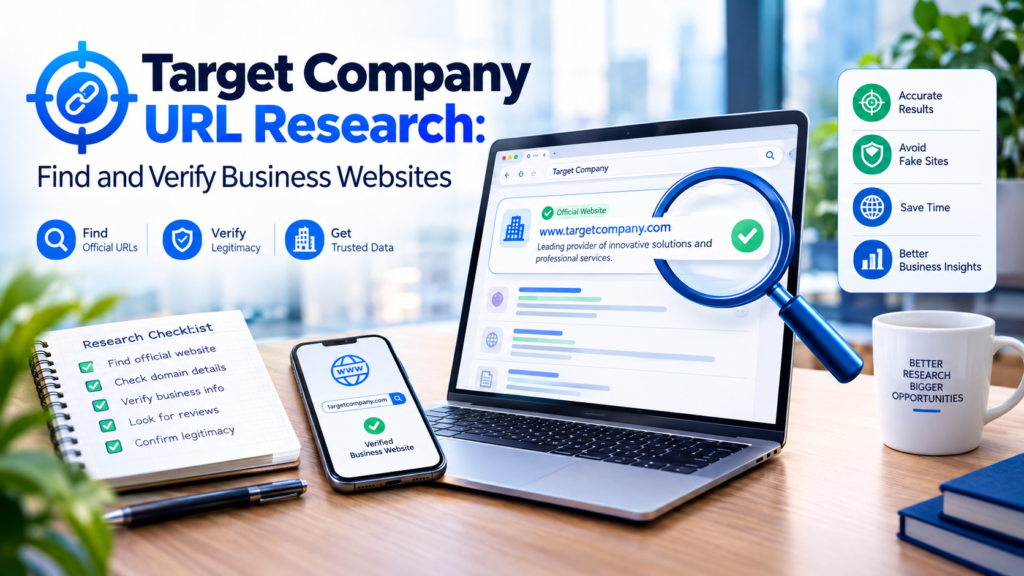
Target company URL research involves finding and validating the official web address associated with a specific business. The objective is to establish which domain represents the intended company before collecting information about its products, services, leadership, operations, or commercial activities.
For example, a sales team might receive a spreadsheet containing 100 potential clients. The spreadsheet may include company names but no website addresses. Researchers need to identify the appropriate domains before examining those businesses or preparing personalized outreach.
The process can be used for both small businesses and large organizations. However, the amount of verification required varies depending on the company’s size, its international presence, and the number of businesses operating under similar names.
🔗 You may also like: Growth Navigate Funding
Understanding Domains and URLs
The terms domain and URL are related, but they do not mean the same thing.
- Domain name: The registered web address identifying a website, such as Techhuda.com.
- URL: The complete address of a particular web resource, such as https://Techhuda.com/about.
- Subdomain: A separate section of a domain, such as careers.Techhuda.com.
- Official company website: A website that the company operates or officially designates to represent its business.
In practical research, the domain is usually sufficient for identifying a company’s main website. More detailed URLs become important when locating specific resources, such as careers pages, investor information, product documentation, or corporate leadership profiles.
Why Company Website Research Matters
An accurate website helps researchers access information directly from the business rather than relying exclusively on third-party summaries. It can provide details about services, pricing, company locations, customer segments, partnerships, and official announcements.
The correct domain also improves data quality when importing prospect lists into customer relationship management (CRM) systems. If the wrong website is attached to a company record, subsequent research may identify the wrong contacts, competitors, or business opportunities.
For researchers working with hundreds or thousands of records, even a small number of incorrect matches can create unnecessary work. A consistent verification process helps reduce these errors before they spread into other business systems.
How to Find a Target Company’s Official Website
There are several ways to discover a company’s website. The most appropriate method depends on the quality of the available company information, the number of records, and the level of certainty required.
1. Search the Company Name
Start with the company’s commonly used trading name. If the name is ambiguous, include additional identifying information, such as its industry, city, country, or legal name.
For example, a search for a business called Atlas might return companies in manufacturing, technology, logistics, and financial services. Adding a location or product category can narrow the results.
Search operators can also help researchers locate relevant pages. Quotation marks can be used to search for an exact phrase, while the site: operator limits results to a specified domain.
The first result should be treated as a candidate, not automatic proof of ownership. Sponsored advertisements, directory listings, and similarly named businesses may appear alongside the official website.
2. Check the Company’s Own Information
Once you identify a possible domain, open the website and examine its About, Contact, Products, or Services pages. Look for a consistent company name, a clear description of its activities, and contact details that match the intended business.
A genuine website should make sense in the context of the company being researched. If the company is known for providing enterprise software but the candidate website describes an unrelated local retail business, the match is probably incorrect.
Check the footer for legal notices, privacy policies, terms of service, and the name of the organization responsible for the website. These details can help establish a connection between the domain and the business.
3. Confirm the Company’s Identity
For businesses with common names, verify additional information before accepting a domain. Compare the company’s location, industry, known brands, and legal identity against independent records.
Depending on the country and company type, useful sources may include official business registries, securities filings, professional associations, and verified corporate social profiles.
Large organizations may maintain separate websites for their parent company, consumer brands, regional operations, and investor relations. The right website therefore depends on the specific entity or business activity being researched.
Using a Company URL Lookup Tool
When a prospect list contains many company names, an automated URL lookup tool can make the initial discovery process faster. Instead of searching for each business separately, researchers can submit multiple names and review the candidate domains together.
A typical bulk lookup workflow has three stages.
Step 1: Prepare and Submit Company Names
Place one company name on each line. A spreadsheet column can usually be copied directly into the input field.
Before submitting the list, remove blank rows, duplicate entries, unnecessary punctuation, and information that does not help identify the business. Legal suffixes such as Inc., LLC, Ltd., or GmbH may be useful for distinguishing legal entities, so remove them only when the lookup tool handles them appropriately and the distinction is not important.
Using the company’s recognizable trading name often improves discovery, particularly when its formal registered name differs from the brand used publicly.
Step 2: Review the Matching Results
A lookup tool may return the submitted name, the matched company name, a suggested domain, and a confidence or similarity score.
The matched name helps researchers determine whether the result appears relevant. A score can help prioritize records for manual review, but its meaning depends on how the tool calculates it.
For example, a high text-similarity score may indicate that two company names are nearly identical. It does not necessarily prove that the suggested domain belongs to the intended organization.
Open alternative candidates whenever the tool provides them. This is particularly important for short names, international businesses, and companies that share similar branding.
Step 3: Export and Verify the Results
After reviewing the matches, export the data into a CSV file or spreadsheet. Keep the original company name alongside the matched name and suggested domain so that every result can be traced back to its source record.
Prioritize strong matches, but do not automatically accept every result with a high score. Review uncertain matches manually, and investigate important accounts more carefully before adding their information to a CRM or using them for business outreach.
Automated lookup is best understood as a discovery and matching process. Final verification remains a separate responsibility.
What Does a Company URL Match Score Mean?
A match score helps researchers assess how closely a suggested company record corresponds to the name they entered. However, different tools use different scoring methods, and a score should always be interpreted according to the provider’s documentation.
A name-similarity score is not the same as domain ownership verification, legal identity verification, or proof that a company is currently operating.
A practical review system can use three categories:
- High-confidence candidate: The name and domain appear consistent with the intended business, with supporting details that match.
- Medium-confidence candidate: The name is plausible, but further checks are needed to distinguish it from similar businesses.
- Low-confidence candidate: Important details are missing or inconsistent, making the result unsuitable for automatic acceptance.
These are useful internal review categories, not universal scoring standards. A researcher should avoid treating an arbitrary percentage as a guarantee of accuracy.
For example, a company called Mercury might have several unrelated businesses using the same name. Even an exact name match may identify the wrong organization if the industry and location are not considered.
The best approach is to combine automated matching with contextual checks, using more detailed verification for important accounts.
🔗 You may also like: SEO by HighSoftware99.com vs Traditional SEO
How to Verify That a Business Website Is Official
Website verification is the most important quality-control stage in target company URL research. It helps distinguish a legitimate corporate website from unrelated domains, third-party directories, impersonation sites, and outdated web addresses.
Examine the Domain Carefully
Check the spelling of the domain character by character. Pay attention to added words, unusual hyphens, alternative extensions, and characters that resemble one another.
A familiar company name appearing in a domain does not establish that the company owns or operates it. Similarly, a website that copies another company’s branding may not be affiliated with that organization.
When necessary, consult domain registration records and historical website records. Privacy-protected registration details may limit what can be established, so domain records should be treated as supporting evidence rather than conclusive proof.
Check HTTPS and Browser Security
An official business website will often use HTTPS, which encrypts information exchanged between the browser and the website. This is particularly important when a site collects customer details or processes transactions.
However, HTTPS alone does not prove that a website belongs to a particular company. Fraudulent and unrelated websites can also obtain valid TLS certificates.
Treat secure connections as a basic technical check, then continue verifying the company’s identity through other sources.
Compare Contact and Legal Details
Review the website’s published address, telephone number, corporate email domain, and legal notices. Compare these details with independent business records or other official company channels when available.
Differences do not always indicate fraud. A company may operate through subsidiaries, use a registered office different from its main headquarters, or maintain different contact details in different countries.
The purpose is to understand and document discrepancies rather than reject every website that lacks a perfect match.
Check Official Social Profiles
Look for the company’s established professional or social media profiles. A profile that links to the candidate domain can provide useful supporting evidence, especially when the company also links back to that profile from its website.
Consider the account’s history, branding, published information, and consistency with other company records. A profile displaying a company logo is not sufficient by itself to establish authenticity.
For high-priority businesses, use multiple independent indicators before accepting the domain.
Researching Company Websites After Verification
Once the correct domain has been identified, it becomes the starting point for deeper business research. The information collected should depend on the purpose of the investigation rather than on a fixed list of fields that every company must provide.
Company Overview and Business Model
Start with the About page and the main product or service pages. Record what the company sells, which customers it serves, and how its offerings are positioned in the market.
Look for evidence of its revenue model, such as subscriptions, direct product sales, licensing, commissions, or professional services. Distinguish between what the company explicitly states and what you infer from its offerings.
Leadership and Company Structure
Leadership pages and corporate announcements can identify executives, founders, and business divisions. For public companies, official regulatory filings may provide more detailed information about directors, executive responsibilities, ownership disclosures, and governance.
Check publication dates carefully. Executive titles and company structures can change, so older biographies should not be assumed to describe the current organization.
Careers and Recruitment
The careers section may provide information about hiring locations, job functions, and the skills a company is seeking. It can help job seekers locate official vacancies and help researchers understand a company’s stated recruitment priorities.
However, a careers page does not necessarily indicate that a role is still open. Confirm individual vacancies through the company’s current recruitment system before relying on them.
Financial and Investor Information
Public companies often publish investor relations materials, annual reports, earnings releases, and regulatory filings. These sources are more appropriate for verifying financial information than marketing pages or unsourced directory entries.
In the United States, the Securities and Exchange Commission’s EDGAR database provides access to filings from reporting companies. Other jurisdictions maintain their own corporate disclosure and regulatory systems.
Private companies may disclose less financial information. Do not estimate or present unavailable financial metrics as verified facts.
Competitors and Digital Presence
After identifying the correct domain, compare the company’s products, target market, geographic coverage, and positioning with those of relevant competitors.
SEO tools can help researchers examine organic visibility, keyword coverage, backlinks, and website structure. These measurements provide useful competitive context, but third-party traffic and keyword estimates should not be confused with the company’s actual internal analytics.
Use the same measurement approach across competitors to make comparisons more meaningful.
Best Tools for Target Company URL Research
Different tools support different stages of company website discovery. Some help identify domains, while others verify legal identities, locate official documents, or analyze competitors.
Search Engines
Search engines are useful for discovering potential company websites, locating official announcements, and finding specific pages. Queries combining a company name with its industry or location can be particularly helpful for businesses with common names.
Business Registries
Government registries can help confirm a company’s registered name, legal status, and jurisdiction. For example, Companies House serves as the official register of companies in the United Kingdom, while the U.S. Securities and Exchange Commission publishes disclosures from reporting companies.
These records may identify a legal entity without establishing which public-facing website it uses. Connect registry information with the company’s own disclosures whenever possible.
Domain Research Tools
Domain lookup and DNS tools can provide technical information about a domain, including name servers, DNS records, and certain registration details. Historical website archives can help researchers investigate rebranding or changes in a company’s online presence.
No single technical record proves that a business owns a domain. Combine available technical evidence with official company information.
SEO and Company Data Platforms
Platforms such as Ahrefs and Semrush support competitor website analysis, while providers such as Hunter.io, Apollo.io, and ZoomInfo offer various business research and contact-enrichment capabilities.
Their features, pricing, coverage, and access requirements differ. Before selecting a provider, determine whether you need only company domains or additional information such as employee estimates, business locations, industry classifications, or professional contact details.
For a small list, manual research may be sufficient. For a large prospecting operation, automated lookup combined with paid enrichment may be more efficient.
🔗 You may also like: Quartz Events Sponsor Matching Companies
Manual Research vs. Automated URL Lookup
Both approaches can produce useful results, but they serve different needs.
| Method | Best use | Main limitation |
| Manual search | Small or ambiguous company lists | Time-consuming at scale |
| Bulk URL lookup | Discovering domains for many company names | Requires verification of uncertain matches |
| Business registries | Confirming legal identity and registration | May not identify the public-facing website |
| SEO platforms | Competitor and website analysis | Estimates may differ from actual business data |
| Data enrichment providers | Combining domains with company and contact details | May require payment and account registration |
A practical workflow combines these methods instead of relying entirely on one. Bulk lookup can handle initial discovery, while manual searches and authoritative records resolve ambiguous matches.
The right balance depends on list size, data quality, budget, and the consequences of an incorrect result.
How to Organize Company URL Research in a Spreadsheet
A structured spreadsheet makes research easier to review, update, and share with other teams. It also helps prevent incorrect matches from entering sales and marketing systems.
Consider creating the following columns:
| Column | Purpose |
| Original company name | Preserves the name from the original list |
| Matched company name | Records the identity returned by the lookup |
| Official domain | Stores the accepted website domain |
| Full URL | Records the relevant page when needed |
| Country or location | Helps distinguish similarly named businesses |
| Verification status | Tracks whether the domain has been checked |
| Evidence source | Links to the supporting company or registry page |
| Last checked | Records when the information was reviewed |
| Research notes | Explains ambiguities or unresolved issues |
Use consistent verification labels, such as Verified, Needs Review, and Unconfirmed. These labels describe the research status rather than guaranteeing that a business is legitimate.
For example, a record might contain a company name, its proposed domain, a link to the company’s About page, a matching business registry entry, and the date of the review. Another researcher can then understand why the domain was accepted.
Keep the original company name even if you normalize names for matching. This makes it easier to trace records back to their sources and correct mistakes later.
Common Mistakes in Target Company URL Research
Several avoidable errors can reduce the quality of a company website dataset.
Accepting the First Search Result
The first result may be an advertisement, directory listing, competitor, or unrelated business. Always inspect the candidate website and compare its details with the intended company.
Trusting a Match Score Without Verification
A high similarity score can indicate a close name match without confirming domain ownership. Treat scores as prioritization signals rather than proof.
Confusing a Brand With Its Parent Company
A consumer brand may belong to a larger corporate group. If the research concerns ownership, financial performance, or executive leadership, the brand website alone may not provide the necessary information.
Record both the brand domain and the parent company’s official domain when they serve different research purposes.
Ignoring Regional Websites
International companies may operate country-specific websites with different products, pricing, languages, or legal entities. Select the relevant regional site for local prospecting and the parent corporate website for group-level research when appropriate.
Using Outdated Domains
Companies sometimes rebrand, acquire other businesses, or change their web addresses. A domain that appeared correct in an old spreadsheet may no longer represent the current organization.
Recheck key records periodically and preserve the date each domain was verified.
Collecting More Information Than Necessary
Research becomes inefficient when teams collect extensive company data before defining their objectives. Establish whether the task requires only a domain list or a more detailed business profile.
Collecting only the information needed for the intended purpose reduces unnecessary work and makes the resulting dataset easier to maintain.
A Practical Target Company URL Research Workflow
A repeatable process improves consistency across sales, recruiting, SEO, and market research projects.
Step 1: Define the research objective. Decide whether the list will support sales prospecting, competitor analysis, recruitment, investment research, or another activity.
Step 2: Prepare the company list. Standardize formatting, remove accidental duplicates, and keep legal names and identifying details when they help.
Step 3: Run the initial lookup. Use a search engine or bulk lookup tool to identify candidate domains.
Step 4: Verify the matches. Review company descriptions, contact information, legal notices, and independent records. Investigate alternative candidates for ambiguous names.
Step 5: Record supporting evidence. Save the source URLs, verification status, and review date alongside each accepted domain.
Step 6: Export and review. Remove duplicate records, resolve uncertain matches, and check that the dataset is ready for its intended use.
Step 7: Maintain the dataset. Revisit important records when companies rebrand, change ownership, or move to a different domain.
For example, a sales team researching 200 prospective clients could use bulk lookup to generate an initial domain list, manually investigate the ambiguous results, and then enrich verified records with relevant company information. This separates domain discovery from contact research and makes errors easier to identify.
Conclusion
Target company URL research is a foundational step in building accurate business datasets. Identifying a domain is relatively straightforward, but verifying that it represents the intended company requires attention to names, locations, corporate relationships, legal disclosures, and supporting evidence.
A reliable workflow combines automated discovery with manual verification, records the sources behind important decisions, and keeps uncertain matches separate from confirmed results. The amount of research should reflect the task: a simple prospect list may need only verified domains, while investment analysis or enterprise account research requires a broader collection of authoritative company information.
By treating URL lookup as the beginning of research rather than its final answer, businesses can create cleaner datasets, improve prospecting efficiency, and build more dependable foundations for sales, SEO, recruitment, and corporate analysis.
FAQs
What Is Target Company URL Research?
Target company URL research is the process of finding and verifying the official website addresses of businesses being researched. It helps establish the correct digital identity before collecting company information or conducting further analysis.
How Do I Find a Company’s Official Website?
Search for the company’s name using relevant industry and location details. Review the candidate website’s About and Contact pages, check its legal information, and compare its details with authoritative business records or established corporate profiles.
Can I Find Multiple Company URLs at Once?
Yes. Bulk URL lookup tools can process lists of company names and return candidate domains in a single workflow. Results should still be reviewed, especially when company names are ambiguous or the research supports important business decisions.
Are Free Company URL Lookup Tools Reliable?
Free tools can be useful for initial domain discovery, but reliability depends on their data sources, matching methods, and coverage. A free tool may identify the correct domain for a familiar brand but struggle with a small local company or a business with several similar names.
Always verify the results independently.
What Is the Difference Between a Company Domain and a URL?
A domain identifies a website’s registered name, such as Techhuda.com. A URL identifies a particular web resource and may include a protocol, subdomain, and page path, such as https://Techhuda.com/careers.