

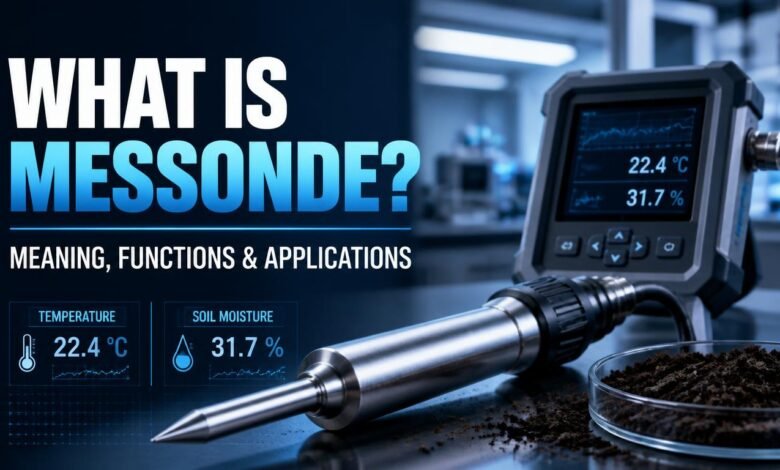
Messonde is a term that appears in online searches related to measurement technology, sensors, and technical equipment. People searching for this word may be trying to understand its definition, discover how it works, or identify the type of device associated with it. The term can be confusing because it is often used interchangeably with the German technical word Messsonde, which refers to a measuring probe.
A measuring probe is a device designed to detect or measure a particular physical condition, such as temperature, moisture, pressure, or the properties of a material. These devices are widely used in laboratories, agriculture, manufacturing, environmental monitoring, and industrial processes. Their purpose is to collect information that helps people understand conditions, monitor changes, and make informed decisions.
However, it is important to distinguish between the spelling of a term and the technology it describes. Messonde is not necessarily the official name of a particular product, company, or software platform. In many technical contexts, it may be a spelling variation or misspelling of Messsonde. Understanding this distinction provides a more accurate starting point for exploring its meaning, functions, and applications.
This article explains the possible meaning of Messonde, its relationship with Messsonde, the working principles of measuring probes, their main types, practical uses, accuracy, maintenance, and selection considerations.
What Is Messonde?
Messonde is a term that is commonly associated in online content with measuring probes and sensor technology. When used in this context, it generally points toward equipment that collects measurements from a physical environment or material.
The term itself requires some care because its spelling is not the standard German form commonly used for a measuring probe. The German word is Messsonde. Therefore, someone searching for Messonde may be looking for information about Messsonde equipment rather than a distinct technical category.
A measuring probe is usually a physical component that comes into contact with a material, enters an environment, or detects a measurable condition. Depending on its design, it may measure temperature, electrical properties, moisture, pressure, or chemical characteristics. The information collected by the probe can then be displayed, recorded, or processed by a connected instrument.
For example, a soil moisture probe can help determine whether agricultural land contains enough water for crops. A temperature probe can monitor heat inside a machine, laboratory sample, or storage facility. An industrial probe may measure a process variable so that equipment operators can maintain suitable operating conditions.
The exact meaning of Messonde therefore depends on the context in which the word appears. It is more accurate to understand the term through its possible connection to measuring probes than to assume that it represents one specific device with a universal set of features.
Messonde vs. Messsonde: Understanding the Spelling
One of the most important aspects of understanding Messonde is recognizing the difference between the searched spelling and the established German term.
Messsonde is a German compound word associated with measurement probes. It combines two elements that help explain its meaning.
- Messen: A German verb meaning to measure.
- Sonde: A probe or instrument used to investigate or measure something.
Together, these elements describe a probe used for measurement or investigation.
Messonde, by comparison, may appear when a person omits one of the repeated letters in Messsonde. This can happen when users type an unfamiliar technical term, copy it from an unreliable source, or encounter different spellings across online publications.
The distinction matters because a spelling variation does not automatically establish a separate technology. If someone is looking for a temperature probe, soil sensor, or industrial measuring instrument, searching for the established technical term and the relevant device type may produce more precise information.
It is also important not to assume that every occurrence of Messonde has the same meaning. A particular business, document, or product could use the word in a different way. The surrounding information should be checked before assigning a definitive meaning.
| 🔗 You may also like: |
| Messagenal: Digital Communication & Messaging Platform Guide |
| Nerwey Explained: Features, Online Platform & User Guide |
How Do Measuring Probes Work?
Although measuring probes differ in construction and purpose, many follow a similar operating process. They detect a physical or chemical property and convert that information into a form that can be interpreted by a person or electronic system.
1. Contacting or Detecting the Target
The first stage involves placing the probe in the environment or material that needs to be measured. A temperature probe may be inserted into a liquid, while a soil sensor may be placed at a selected depth in the ground.
Some probes do not need direct physical contact. Certain optical and electromagnetic instruments can measure properties from a distance or through a suitable surface.
The positioning of the probe is important because the measurement must represent the condition being investigated. An incorrectly positioned instrument may produce readings that do not reflect the wider environment.
2. Detecting a Physical Change
The probe contains a sensing element that responds to a measurable property. Depending on the technology, the element may respond to changes in temperature, electrical resistance, pressure, conductivity, or another physical characteristic.
For example, some temperature sensors change their electrical resistance as the temperature rises or falls. Other designs generate an electrical signal related to the temperature difference between two points.
A moisture probe may measure changes in the electrical properties of soil. The device then uses those measurements to estimate moisture content, depending on its design and calibration.
3. Converting the Signal
The sensing element produces a response that must be interpreted. Electronic circuitry or an external measuring instrument converts the response into a usable signal.
In simple equipment, the measurement may be displayed directly on a connected meter. More advanced systems can process the signal electronically and apply correction factors or calibration data.
The quality of this conversion affects the usefulness of the final reading. Electrical interference, unsuitable operating conditions, damaged components, and poor calibration can all contribute to inaccurate results.
4. Displaying or Recording Results
Once the signal has been processed, the result can be presented as a number, graph, status indicator, or recorded data point.
Some probes work with handheld meters, while others connect to automated monitoring systems. In industrial settings, measurements may be sent to a control system that alerts operators when a value moves outside a specified range.
This process allows measuring probes to support routine inspections, scientific experiments, quality control, and automated operations.
Main Types of Measuring Probes
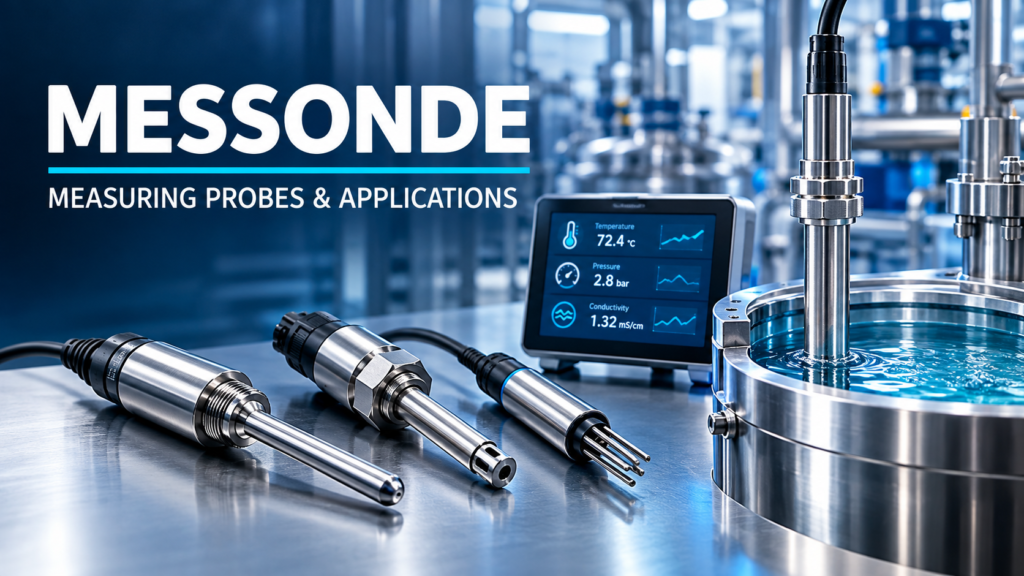
There is no single probe type that covers every possible interpretation of Messonde. Measuring probes are designed for specific properties and operating environments. The following categories illustrate some of the most common technologies associated with measurement equipment.
Temperature Probes
Temperature probes measure how hot or cold a material or environment is. They are used in manufacturing, food storage, laboratories, heating systems, and scientific research.
Different designs suit different temperature ranges and levels of precision. Resistance temperature detectors, thermistors, and thermocouples are examples of technologies used in temperature measurement.
A suitable probe must be selected according to the expected temperature, response time, environmental conditions, and required accuracy. A probe designed for ordinary indoor monitoring may not be suitable for extreme heat or corrosive industrial conditions.
Soil Moisture Probes
Soil moisture probes help estimate the amount of water present in soil. They are particularly useful in agriculture, horticulture, landscaping, and irrigation management.
Some sensors estimate moisture by measuring electrical resistance or conductivity. Others use capacitance or related electromagnetic methods to estimate the soil’s water content.
Farmers and growers can use these measurements to understand changing soil conditions and improve irrigation decisions. However, readings may be influenced by soil composition, salinity, installation depth, and sensor calibration.
A moisture reading should therefore be interpreted in relation to the specific soil and the requirements of the crop rather than treated as a universal indicator for every field.
Pressure Probes
Pressure probes are designed to measure pressure in gases or liquids. They are relevant to industrial machinery, fluid systems, laboratory equipment, and certain environmental monitoring applications.
Depending on their construction, these devices may measure absolute pressure, gauge pressure, or differential pressure. Each measurement type serves a different purpose.
For example, an industrial system may monitor pressure to identify unusual operating conditions. A differential pressure sensor may help determine the pressure difference across a filter or other component.
Pressure measurement equipment must be compatible with the expected pressure range and the material it encounters. Incorrect selection can lead to unreliable readings or equipment damage.
🔗 You may also like:
Bilieter Explained: Features, Uses & Everything You Need to Know
Voozon Explained: Digital Platform Features & Services
Electrical Conductivity Probes
Electrical conductivity probes measure how readily a material conducts electricity. In liquid analysis, conductivity can provide information about the concentration of dissolved ions, although it does not identify every substance present.
These probes are used in water treatment, laboratories, agriculture, aquaculture, and industrial process monitoring.
In agriculture, conductivity measurements can help assess certain aspects of soil or irrigation water. In industrial applications, they may support water-quality checks and process control.
Conductivity is not the same as a complete chemical analysis. A reliable interpretation requires an understanding of the sample, measurement conditions, and limitations of the instrument.
Chemical and Environmental Probes
Some probes are designed to detect specific chemical properties or environmental conditions. Examples include pH electrodes, dissolved oxygen sensors, and instruments that monitor selected gases.
These devices are used in laboratories, wastewater treatment, environmental studies, aquaculture, and manufacturing.
Their operation depends on the sensing technology involved. A pH electrode, for instance, measures an electrical potential associated with the acidity or alkalinity of a solution. A dissolved oxygen sensor uses a different mechanism to estimate oxygen concentration.
Because these probes respond to particular substances or conditions, their accuracy depends on appropriate calibration, maintenance, and correct use.
Common Applications of Measuring Probes
Measuring probes support a wide range of activities. Their importance comes from their ability to provide information about conditions that may not be obvious through visual inspection alone.
Agriculture and Irrigation
Agriculture is one of the major fields in which measurement technology can improve day-to-day decisions. Soil moisture sensors help growers monitor water availability and understand how conditions change after rainfall or irrigation.
Temperature and conductivity measurements can provide additional information about growing environments and water quality. When these measurements are interpreted correctly, they can support more consistent crop management.
However, sensors do not replace agricultural knowledge. Soil type, crop requirements, weather conditions, root depth, and irrigation methods all influence how readings should be used.
Industrial Manufacturing
Manufacturing processes often require close monitoring of temperature, pressure, moisture, and other variables. Measuring probes help operators check whether equipment is functioning within its intended operating range.
For example, a temperature probe may monitor heating equipment, while a pressure sensor may help identify an unexpected change in a fluid system.
Measurement data can also contribute to quality control. If a process variable moves outside its acceptable range, the information may prompt an inspection before the problem affects a larger batch of products.
The specific benefits depend on the sensor, the process, and how measurement data are integrated into the production system.
Laboratories and Scientific Research
Laboratories depend on accurate measurements to produce useful and repeatable results. Researchers may use probes to monitor sample temperature, solution pH, conductivity, dissolved oxygen, and other properties.
The choice of instrument depends on the research question. A device suitable for general demonstrations may not provide the accuracy or documentation needed for specialized analytical work.
Researchers also need to consider measurement uncertainty, calibration records, environmental conditions, and the possibility of contamination. These factors are essential when comparing results or repeating an experiment.
Environmental Monitoring
Environmental monitoring involves observing conditions in air, water, soil, and other natural systems. Measuring probes can collect data about temperature, water chemistry, moisture, and selected environmental indicators.
These measurements may help researchers investigate changes over time, assess local conditions, or monitor the performance of environmental management systems.
The quality of environmental data depends on more than the sensor alone. Probe placement, sampling frequency, weather, maintenance, and data validation all affect how useful the results will be.
Food Storage and Processing
Food production and storage require careful control of certain conditions. Temperature probes, for example, help monitor refrigeration systems, cooking processes, and storage environments.
Depending on the application, measurement equipment can help verify that conditions remain within specified limits. This can support quality assurance and food-safety procedures.
The correct instrument and procedure must be used for the task. A temperature reading from a storage room does not necessarily establish the internal temperature of a food item, and monitoring equipment should not replace applicable safety standards.
Why Accuracy Matters in Probe Technology
Accuracy is a central consideration whenever measuring probes are used. A device can provide a numerical result without that result being sufficiently close to the actual value.
Several factors influence measurement accuracy.
Calibration: Calibration compares an instrument’s readings with a suitable reference. It helps identify measurement errors and determine whether adjustments or corrections are needed.
Sensor quality: The design, materials, and condition of the sensing element influence its performance. A low-cost sensor may be suitable for general monitoring but inadequate for applications requiring tighter tolerances.
Environmental conditions: Humidity, vibration, electrical interference, temperature extremes, and exposure to chemicals can affect some types of probes.
Installation and positioning: The sensing element must be placed appropriately. Incorrect depth, poor contact, or an unsuitable measurement location can distort results.
Response time: A probe may require time to reach a stable reading. Recording the result too early can produce an inaccurate representation of the target condition.
Accuracy requirements depend on the application. General garden monitoring, for example, may tolerate greater variation than a laboratory procedure or a tightly controlled manufacturing process.
Calibration and Maintenance of Measuring Probes
Regular maintenance helps keep measuring equipment reliable. The exact procedure depends on the probe type, manufacturer instructions, and operating environment.
Clean the Probe Correctly
Residue, dust, soil, and chemical deposits can interfere with the sensing surface. Cleaning should follow the instructions for the particular instrument because some sensing elements are delicate or sensitive to specific cleaning products.
A probe used in food processing or laboratory work may require additional cleaning and handling procedures to prevent contamination.
Check Calibration
Calibration should be performed at intervals appropriate to the equipment and its use. Some applications require documented, traceable calibration, while others may use routine checks against a known reference.
A probe that has been dropped, exposed to extreme conditions, or used with aggressive chemicals may need inspection or recalibration before further use.
Inspect Cables and Connections
Electrical probes often rely on cables, connectors, and external measuring instruments. Loose connections, damaged insulation, corrosion, or worn components can affect readings.
Routine inspection can help identify visible problems before they lead to measurement failures.
Store Equipment Properly
Probes should be stored according to their design requirements. Some must remain dry, while others require protective caps or special storage solutions to preserve the sensing element.
Following manufacturer guidance helps extend the useful life of the instrument and reduces the risk of avoidable damage.
How to Choose the Right Measuring Probe
If you are researching Messonde because you need measurement equipment, selecting the correct probe starts with identifying the property you want to measure.
First, determine the measurement target. Temperature, soil moisture, pressure, pH, and electrical conductivity require different sensing technologies. A general-purpose probe cannot automatically measure all these variables.
Next, consider the expected operating range. A device must be suitable for the temperatures, pressures, chemicals, and environmental conditions it will encounter. Using equipment outside its specified range may produce unreliable results or create safety risks.
Accuracy and response time are also important. Some tasks require fast measurements, while others depend on stable readings over longer periods. The instrument’s specifications should match the practical requirements of the application.
Compatibility should not be overlooked. Check whether the probe works with the required meter, controller, data logger, or monitoring system. Connector types, signal formats, software support, and power requirements may influence the choice.
Finally, review the manufacturer’s documentation, calibration requirements, warranty conditions, and replacement-part availability. A suitable probe should not only provide the necessary measurements but also be practical to maintain over its expected service life.
Advantages and Limitations of Measuring Probes
Measuring probes offer several useful advantages. They can collect information quickly, support continuous monitoring, improve consistency, and reduce reliance on subjective visual judgments. When connected to automated systems, they can also help operators identify changes and respond more efficiently.
Another benefit is their versatility. Different probe designs can be used in laboratories, agricultural settings, industrial processes, and environmental studies. This makes measurement technology useful for both routine checks and specialized investigations.
Nevertheless, probes have limitations. Their readings may be affected by poor calibration, unsuitable placement, sensor ageing, environmental interference, and incorrect interpretation. Some instruments measure an indirect indicator rather than the exact property a user ultimately wants to understand.
For example, an electrical conductivity measurement can provide useful information about a solution but cannot identify every dissolved chemical. Similarly, a soil moisture sensor may require calibration for a particular soil type.
The most reliable approach is to understand what the instrument actually measures and use its results within the limits specified by its manufacturer.
Is Messonde a Product, Software, or Technical Device?
The answer depends on the context in which the term appears. The word Messonde alone is not enough to establish that it refers to a particular commercial product, software application, or registered brand.
In technical discussions, the closest established term is Messsonde, which describes a measuring probe. A probe is generally a physical measurement component rather than a standalone software platform.
However, a similarly spelled name could be used by an individual company or product. Confirming that interpretation would require product documentation, a manufacturer’s official description, or another reliable source that identifies the specific item.
It is also possible that someone searching for Messonde has encountered the term in an article, catalogue, technical document, or online discussion and simply wants to understand it.
For that reason, it is best to evaluate the surrounding context rather than assign a single meaning to every occurrence of the word. This distinction helps avoid confusion between a general technical term and a particular commercial offering.
Common Misunderstandings About Messonde
Several misunderstandings can arise when a relatively unfamiliar technical word appears online.
One common mistake is assuming that Messonde and Messsonde are always separate technologies. The spelling difference alone does not prove that two distinct devices exist.
Another mistake is treating every measuring probe as interchangeable. Temperature sensors, pressure probes, moisture sensors, and chemical electrodes perform different functions and operate according to different principles.
Some readers may also assume that a probe automatically provides perfectly accurate measurements. In reality, readings depend on the instrument’s specifications, calibration, installation, operating conditions, and maintenance.
Finally, an article that associates Messonde with a specific software service or commercial brand should provide evidence for that connection. Without reliable supporting information, it is more appropriate to describe the established measuring-probe terminology and acknowledge that the exact meaning may vary by context.
Conclusion
Messonde is a term that can cause confusion because it is frequently associated with the German technical word Messsonde, meaning a measuring probe. Understanding this spelling distinction is the first step toward identifying the technology that someone may be searching for.
Measuring probes play an important role in collecting information about physical and chemical conditions. Depending on their design, they can measure temperature, soil moisture, pressure, electrical conductivity, pH, and other properties. Their applications range from agriculture and industrial manufacturing to scientific research, environmental monitoring, and food storage.
Reliable measurements depend on choosing the appropriate instrument, following installation instructions, maintaining the sensing element, and checking calibration when necessary. It is equally important to understand the limits of each measurement rather than assuming that all probes provide the same information.
Ultimately, the most useful way to understand Messonde is to examine the context in which it appears and distinguish a possible spelling variation from a verified product or brand. This approach provides a clearer, more accurate understanding of the term and the measurement technology associated with it.
FAQs
What does Messonde mean?
Messonde is a term often associated online with measuring probes. It may be a spelling variation or misspelling of the German technical word Messsonde, meaning a measuring probe. Its precise meaning depends on the context in which it appears.
What is the correct spelling: Messonde or Messsonde?
Messsonde is the established German spelling for a measuring probe. Messonde may appear as a variation or typo, so people looking for technical equipment should check the spelling used by the relevant manufacturer or technical source.
What is a measuring probe used for?
A measuring probe detects or measures a particular property, such as temperature, moisture, pressure, conductivity, or pH. These instruments are used in agriculture, manufacturing, laboratories, food processing, and environmental monitoring.
Is Messonde a sensor?
Messonde is not sufficiently specific on its own to identify a particular sensor model. If the term is being used as a variation of Messsonde, it refers generally to a measuring probe, which may incorporate a sensor or sensing element.
Can measuring probes be used in agriculture?
Yes. Agricultural applications include monitoring soil moisture, measuring temperature, checking water conductivity, and collecting information about growing conditions. The appropriate device depends on the property being measured and the requirements of the crop or operation.
Do measuring probes require calibration?
Many measuring probes require calibration or periodic verification to maintain reliable results. The recommended interval depends on the instrument, its operating conditions, the manufacturer’s guidance, and the accuracy requirements of the application.
How long does a measuring probe last?
The lifespan varies by sensor design, construction, frequency of use, and exposure to harsh conditions. Proper cleaning, storage, inspection, and calibration can help maintain performance, but some sensing elements eventually need replacement.
Is Messonde related to software?
The term alone does not establish a connection to a particular software application. In the technical context discussed here, its likely connection is to measuring-probe terminology. A specific software-related meaning would need separate verification.