
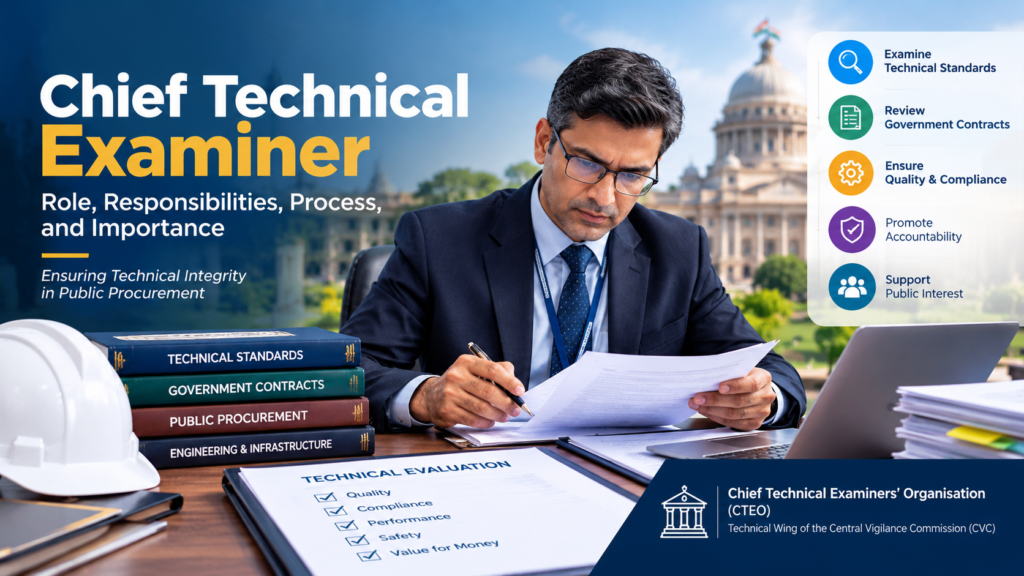
A Chief Technical Examiner (CTE) plays an important role in examining government contracts, reviewing technical standards, and promoting accountability in public procurement. In India, the position is closely associated with the Chief Technical Examiners’ Organisation (CTEO), which serves as the technical wing of the Central Vigilance Commission (CVC).
Government projects often involve complex engineering work, detailed contracts, substantial expenditure, and strict technical requirements. Independent technical examination helps determine whether approved procedures have been followed, project specifications have been met, and payments are supported by reliable records.
Understanding the Chief Technical Examiner role is useful for engineers, government employees, contractors, procurement professionals, and students interested in public administration. This guide explains the meaning of CTE, its main responsibilities, the CTEO framework, the examination process, relevant skills, and the importance of technical oversight in government projects.
What Is a Chief Technical Examiner?
A Chief Technical Examiner is a senior technical officer responsible for examining selected technical, contractual, and financial aspects of projects or procurement activities within an assigned oversight framework.
In India, the title has a specific institutional connection with the CTEO under the Central Vigilance Commission. The organisation provides technical expertise to examine selected public procurement cases and support vigilance-related work.
The examination may cover project estimates, tender conditions, contract agreements, material quality, measurements, payment records, and compliance with applicable specifications. The objective is to establish whether procurement decisions and project execution are properly supported by technical and financial evidence.
For example, a government department may hire a contractor to construct a public building. A technical examination could compare the approved drawings with the completed work, review material testing reports, and check whether the quantities claimed in payment bills match the recorded measurements.
If discrepancies are identified, the responsible authorities can request explanations and determine whether corrective action, financial recovery, or further investigation is appropriate. A discrepancy alone does not automatically establish fraud or corruption; the available evidence and circumstances must be assessed.
| 🔗 You may also like: |
| Research Dossier for Target Company |
| Target Company URL Research |
What Is the Chief Technical Examiners’ Organisation (CTEO)?
The Chief Technical Examiners’ Organisation, commonly called CTEO, is the technical wing associated with India’s Central Vigilance Commission. Its work involves the technical examination of selected government procurement cases that require engineering, contractual, or specialised technical knowledge.
The organisation helps address questions that cannot always be resolved through routine financial checks alone. An invoice, for instance, may show the amount paid for construction work, but technical verification may be necessary to establish whether the recorded quantities and specified materials correspond with what was actually delivered.
CTEO’s examination work can cover civil engineering, electrical and mechanical works, supplies, equipment, information technology procurement, consultancy, transport, and other services, depending on the relevant mandate and case.
Its responsibilities also support preventive vigilance. When an examination identifies weaknesses in tendering, documentation, quality control, or contract management, the findings can help organisations improve their procedures and reduce the likelihood of similar problems in future procurement.
History of the Chief Technical Examiner Role
The Chief Technical Examiners’ Organisation was established in 1957 under the then Ministry of Works, Housing and Supply. Its original purpose was to strengthen technical and financial control over government construction activities and promote economical use of public funds.
In 1964, the organisation came under the administrative control of the Central Vigilance Commission, connecting technical examination more directly with India’s public vigilance framework.
As government procurement expanded beyond traditional construction, technical oversight became relevant to a wider range of contracts. Public organisations increasingly required specialised reviews of equipment, supplies, electrical systems, mechanical installations, consultancy, and other procurement activities.
The CTEO’s work consequently developed beyond checking the quality of completed buildings or infrastructure. Its broader purpose is to examine selected procurement activities, identify technical and financial discrepancies, and help strengthen accountability in public expenditure.
For readers researching the position as a career, it is important to distinguish the CTEO’s institutional history from the eligibility requirements for a particular appointment. Current service rules and official notifications should be consulted for specific recruitment or deputation conditions.
Main Responsibilities of a Chief Technical Examiner
The responsibilities of a Chief Technical Examiner focus on determining whether selected procurement activities comply with relevant technical requirements, contract terms, and financial procedures. The precise scope depends on the project and the applicable examination guidelines.
1. Examining Project Estimates and Approvals
Before a government project begins, the responsible department prepares estimates, defines the scope of work, and obtains the required approvals. A technical examination may assess whether the estimates are adequately supported by quantities, specifications, and applicable rates.
The examiner may review the basis for estimated costs, technical sanctions, administrative approvals, and changes made during project planning. Unexplained rates or quantities may require additional justification.
For example, if an infrastructure project includes unusually expensive materials, the examination may consider whether the selected specifications and estimated prices are supported by the project requirements.
2. Reviewing Tendering and Procurement
Tendering determines how contractors or suppliers compete for government contracts. A Chief Technical Examiner may examine tender conditions, eligibility requirements, bid comparisons, evaluation records, and the basis for awarding a contract.
The review can identify conditions that appear unnecessarily restrictive, inconsistencies in bid evaluation, or departures from the applicable procurement procedure. It may also assess whether technical requirements are clearly defined and relevant to the work.
A fair and properly documented tender process helps protect competition and makes procurement decisions easier to justify.
3. Checking Construction Quality and Technical Compliance
Construction-related examinations may involve comparing completed work with approved drawings, technical specifications, and contractual obligations.
Depending on the project, the examination may cover material quality, workmanship, measurements, testing records, construction methods, and relevant engineering standards. Physical inspection or additional verification may be needed when documents do not adequately establish the condition of the work.
For example, if a road contract specifies a particular pavement thickness, the examiner may compare the specification with available measurements and inspection evidence to determine whether the requirement has been met.
4. Verifying Measurements and Payments
Payment verification is an important part of technical examination because government expenditure should be supported by evidence of the work, goods, or services delivered.
The examiner may compare measurement books, invoices, payment certificates, delivery records, and contract rates. Differences between recorded quantities and actual work can indicate errors or possible overpayments that need further review.
If a contractor has billed for work that cannot be adequately verified, the responsible department may be asked to explain the discrepancy and take appropriate action under the applicable rules.
5. Reviewing Contract Changes and Delays
Government contracts sometimes require changes because of unforeseen site conditions, revised requirements, or other legitimate circumstances. However, changes should be supported by proper reasons and approvals.
A technical examination may review variations in quantities, additional items, revised rates, extensions of time, and changes to the original scope. The aim is to establish whether these decisions were justified and handled according to the contract.
Unexplained changes can increase costs, delay completion, or weaken the original basis on which the contract was awarded.
6. Identifying Irregularities and Recommending Corrective Measures
An examination may identify technical deficiencies, unsupported expenditure, weak documentation, procedural violations, or other irregularities.
The findings can help the relevant authorities decide whether to seek further explanations, correct defects, review payments, recover justified amounts, improve internal controls, or refer serious concerns for additional investigation.
The Chief Technical Examiner does not automatically determine criminal liability simply by identifying a discrepancy. Further action depends on the evidence, the applicable rules, and the authority responsible for the matter.
| 🔗 You may also like: |
| Guru Knowledge Base Software |
| Syrenis Strategic Initiatives |
How Does the CTE Examination Process Work?
A technical examination generally combines document review, technical assessment, verification of relevant evidence, and formal reporting. In the CTEO framework, selected procurement cases may undergo an Intensive Examination, which can involve detailed scrutiny of records and physical work where necessary.
Step 1: Selection of a project
A procurement case is selected according to the applicable examination process, reporting arrangements, relevant concerns, or other selection criteria. Selection alone does not imply that wrongdoing has occurred.
Step 2: Collection of documents
The examination team reviews relevant estimates, approvals, tender documents, agreements, bills, measurement records, test reports, and other supporting evidence.
Step 3: Technical and financial scrutiny
The team compares contractual requirements with recorded quantities, rates, specifications, quality evidence, and payments to identify discrepancies that require explanation.
Step 4: Physical verification where appropriate
Site inspections, measurements, material checks, or other forms of verification may be conducted when needed to establish whether the recorded work matches the actual work or supply.
Step 5: Findings and follow-up
Observations are documented and handled through the applicable reporting process. The organisation concerned may be asked to explain the findings or take corrective action, with further action considered where necessary.
The exact procedure varies according to the contract, the nature of the issue, and the applicable CVC instructions. Not every examination requires every type of document review or physical inspection.
What Types of Projects Can a Chief Technical Examiner Examine?
The scope of work depends on the applicable mandate. Within the Indian CTEO framework, technical examination can cover a range of public procurement activities rather than civil construction alone.
- Civil engineering and infrastructure: Roads, bridges, public buildings, drainage systems, and other construction projects.
- Electrical and mechanical works: Equipment installations, machinery, power systems, and related engineering contracts.
- Government supplies: Purchase contracts involving equipment, materials, and other goods.
- Information technology: Relevant hardware, software, implementation, and IT service procurement.
- Consultancy and professional services: Design, project management, technical consulting, and other contracted services.
- Transport and maintenance: Applicable transport arrangements, maintenance contracts, and service procurement.
The type of examination changes with the contract. A road project may require measurement and material checks, while an IT contract may require review of agreed deliverables, testing records, licensing conditions, and acceptance documentation.
Difference Between CTE and CVO
A Chief Technical Examiner (CTE) and a Chief Vigilance Officer (CVO) have different but complementary responsibilities within India’s vigilance framework.
| Area | Chief Technical Examiner | Chief Vigilance Officer |
| Main focus | Technical and procurement examination | Vigilance matters within an organisation |
| Typical work | Reviewing estimates, contracts, measurements, quality, and payments | Coordinating vigilance activities and follow-up |
| Expertise | Engineering, technical standards, and contract scrutiny | Vigilance procedures, administration, and organisational controls |
| Relationship | Provides technical observations through the relevant process | Helps coordinate responses and appropriate follow-up |
CTEO’s technical findings can be communicated through the relevant vigilance channels, including the concerned CVO. The CVO helps coordinate the organisation’s response and any further action required under the applicable framework.
The two roles are not interchangeable: technical examination supplies specialist evidence, while vigilance functions address the wider organisational and procedural response.
What Qualifications and Skills Are Important?
The CTEO’s Chief Technical Examiner is a senior technical position, not a standard entry-level engineering job. Specific appointment, service, and eligibility requirements must be checked against current official notifications.
Several professional skills are relevant to technical examination work.
Engineering Knowledge
A sound understanding of the relevant engineering discipline helps an examiner interpret specifications, drawings, quantities, test results, and workmanship requirements. The knowledge needed depends on whether the assignment concerns civil, electrical, mechanical, or another technical field.
Procurement and Contract Knowledge
Understanding tender procedures, contract clauses, approved variations, payment conditions, and documentation requirements helps an examiner assess whether decisions are properly supported.
Financial and Analytical Skills
Comparing estimates, rates, measurements, invoices, and actual deliverables requires careful calculations and evidence-based analysis. Small errors can have important financial consequences in large contracts.
Report Writing and Communication
Technical findings must be presented clearly, with the relevant evidence, contractual requirement, discrepancy, and implications explained. Good reporting enables decision-makers to understand the issue without relying on assumptions.
Integrity and Independence
An examiner must remain impartial, avoid conflicts of interest, and distinguish verified facts from allegations or unresolved concerns. The aim is to reach defensible conclusions rather than to presume that every discrepancy indicates misconduct.
| 🔗 You may also like: |
| Growth Navigate |
| Growth Navigate Funding |
Why Is the Chief Technical Examiner Important?
Technical examination helps connect public spending with the actual results delivered by a contract. It can identify weaknesses that routine financial checks may not reveal, especially when an issue concerns engineering specifications, physical quantities, or the quality of supplied goods.
The role supports several important objectives:
- Financial accountability: Identifying unsupported payments, questionable quantities, and cost discrepancies.
- Technical quality: Checking whether relevant contractual specifications and standards have been followed.
- Fair procurement: Examining whether tender conditions and evaluation procedures were handled appropriately.
- Better documentation: Encouraging reliable records of approvals, inspections, changes, and payments.
- Preventive vigilance: Helping organisations address recurring weaknesses instead of focusing only on individual incidents.
A technical examination can also help identify the underlying cause of a problem. Repeated measurement discrepancies, for example, may indicate inadequate supervision or poor recordkeeping that requires a wider procedural improvement.
Common Problems Identified During CTE Examinations
Technical examinations may identify problems at different stages of procurement. The nature and seriousness of each finding depend on the contract and the available evidence.
| Problem | Practical example | Possible impact |
| Inflated estimates | Costs lack adequate rate justification | Unnecessary expenditure |
| Measurement discrepancies | Recorded quantities exceed verified work | Possible overpayment |
| Quality deficiencies | Materials fail specified requirements | Reduced quality or performance |
| Tender irregularities | Unjustified restrictive conditions | Reduced competition |
| Unapproved variations | Contract changes lack required approvals | Cost and compliance concerns |
| Incomplete documentation | Missing test reports or measurement records | Difficulty verifying compliance |
These findings do not automatically establish fraud. The relevant organisation must examine the circumstances, obtain explanations where appropriate, and determine the proper response.
How Organisations Can Prepare for a CTE Examination
Organisations can improve their readiness by maintaining accurate records throughout the procurement process rather than preparing documents only when an examination is expected.
Project teams should keep estimates, technical approvals, tender documents, signed agreements, drawings, measurement books, test reports, invoices, and payment records organised and accessible.
Changes to the original design, scope, quantities, or rates should have documented reasons and the required approvals. Material testing and quality inspections should follow the applicable specifications, with results recorded accurately.
Contractors and government officials should also ensure that payment claims match the work completed or goods and services delivered. Where discrepancies arise, they should be addressed transparently and supported by relevant evidence.
Good preparation is ultimately about sound contract management. Reliable records, appropriate supervision, and consistent quality control make projects easier to examine and help organisations identify problems earlier.
Conclusion
The Chief Technical Examiner plays an important role in promoting technical quality, contractual compliance, and financial accountability in public procurement. In India, the CTEO supports the Central Vigilance Commission by examining selected government contracts and identifying issues that require technical or financial scrutiny.
The role extends beyond inspecting construction sites. It can involve reviewing estimates, tender conditions, contract changes, material quality, measurements, invoices, and payment records. These checks help establish whether public expenditure is supported by evidence and whether contractual requirements have been met.
By identifying discrepancies and highlighting weaknesses in procurement systems, technical examination can support corrective action and better management practices. Its ultimate purpose is to help public organisations use resources responsibly, improve the quality of projects, and strengthen transparency and accountability.
FAQs
What is the full form of CTE?
CTE stands for Chief Technical Examiner. In India, the title is associated with the technical examination of selected public procurement cases under the Central Vigilance Commission framework.
What is the full form of CTEO?
CTEO stands for Chief Technical Examiners’ Organisation. It serves as the technical wing associated with the Central Vigilance Commission in India.
What does a Chief Technical Examiner do?
A Chief Technical Examiner reviews selected procurement cases to examine technical specifications, estimates, tender procedures, contract compliance, measurements, quality records, and payments.
Is CTEO part of the Central Vigilance Commission?
Yes. The CTEO operates as the technical wing of the Central Vigilance Commission and provides specialist technical examination within the applicable vigilance framework.
What is an Intensive Examination?
An Intensive Examination is a detailed review of a selected procurement contract or project. It may include document scrutiny, financial checks, technical verification, and physical inspection where appropriate.