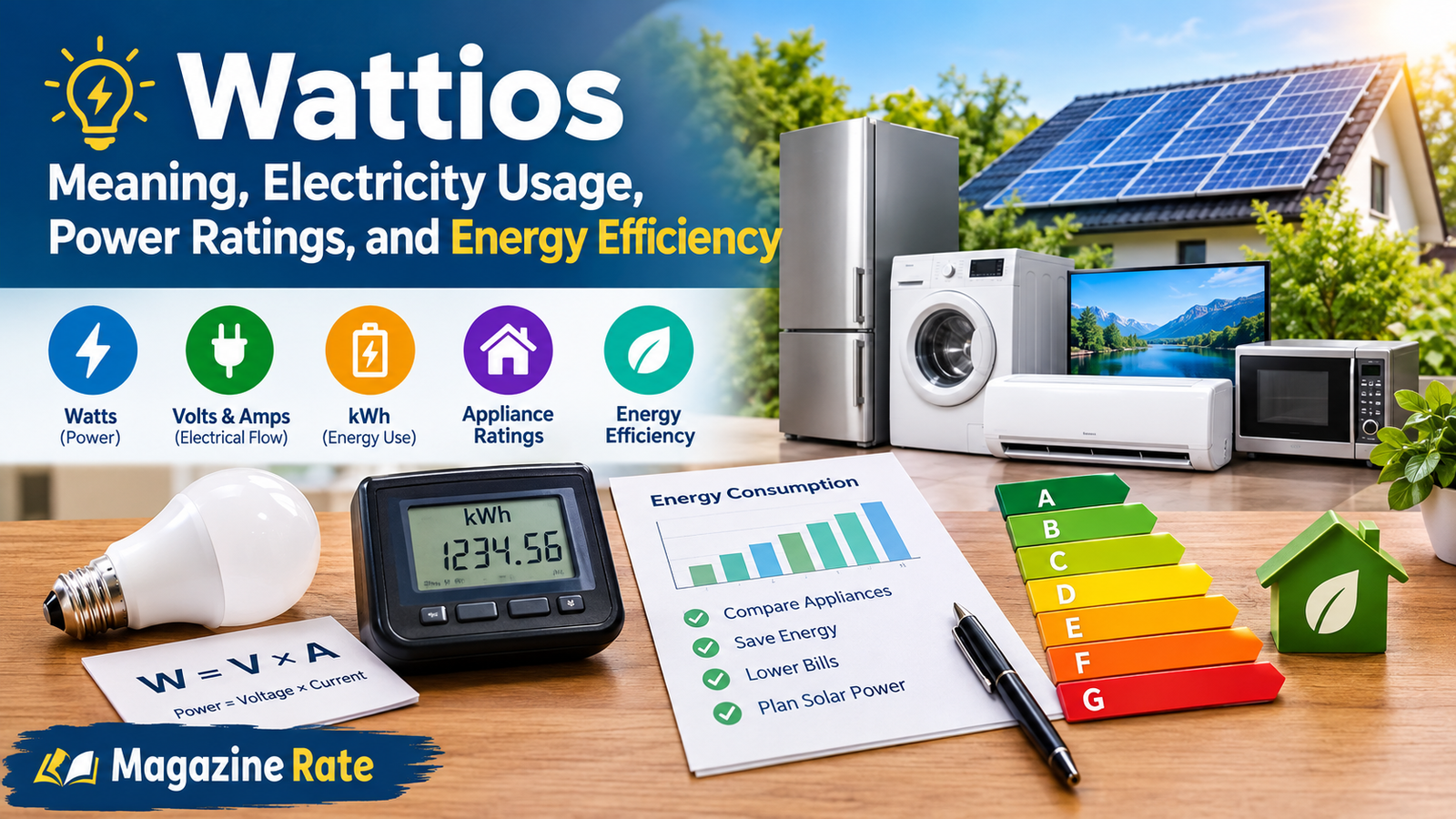
Wattios is a term associated with the watt, the standard unit used to measure electrical power. Understanding this term can help people learn how appliances consume electricity, compare power ratings, estimate energy costs, and make better decisions when buying electrical products. Although Wattios appears in online discussions about electricity, it is not a separate modern unit in the International System of Units (SI).
Electricity consumption depends on several factors, including an appliance’s power rating, operating time, efficiency, and usage patterns. A device with a high wattage does not necessarily consume the most electricity over a month. Its total energy consumption depends on how long it operates and how much power it actually uses.
This guide explains the meaning of Wattios, the difference between watts and kilowatt-hours, how appliance ratings work, and how understanding electrical power can support energy savings and solar power planning.
What Is Wattios?
Wattios is a term associated with the watt and historical Spanish electrical terminology. Older forms such as watio, wattio, and wattios have appeared in Spanish-language contexts, while vatio is the established modern Spanish term for watt.
In modern electrical science, the watt (W) is the standard SI unit of power. It measures the rate at which energy is transferred, generated, or consumed. One watt equals one joule per second.
When people search for Wattios in connection with household appliances, they are often looking for information about electricity consumption, appliance power ratings, and energy efficiency. Understanding these concepts makes it easier to evaluate electrical products and estimate their running costs.
It is important to distinguish the term from a company or product name. Different businesses may use Wattios in their branding, but that does not make it a separate scientific measurement or an official electricity platform.
| 🔗 You may also like: |
| Bodenxt Green Industrial Transformation |
| Matarecycler |
What Is a Watt and Why Does It Matter?
A watt measures how quickly an electrical device uses or transfers energy. Appliance manufacturers commonly display power ratings in watts because this information helps consumers understand the electrical requirements of their products.
For example, a 60-watt light bulb has a rated power of 60 watts under its specified operating conditions. A 1,500-watt heater has a rated power of 1.5 kilowatts. These figures describe power, not the total electricity consumed over a day or month.
Understanding wattage is useful when comparing similar products, checking electrical requirements, and estimating potential energy consumption. It is also important when selecting inverters, backup power systems, and other electrical equipment.
However, a watt rating does not always represent the power an appliance draws continuously. Refrigerators, air conditioners, and computers can change their power consumption depending on their operating conditions.
Watts, Volts, and Amps: Understanding the Difference
Watts, volts, and amps describe different aspects of electricity. Understanding how they relate helps consumers read appliance labels and understand basic electrical calculations.
Watts Measure Power
Watts measure the rate at which energy is transferred or used. A higher wattage generally means an appliance can consume power more quickly when operating at that level.
For example, a 2,000-watt electric heater uses power at a rate of 2 kilowatts when operating at its rated power.
Volts Measure Electrical Potential
Volts (V) measure the electrical potential difference between two points. Electrical appliances are designed to operate within specified voltage ranges.
Checking voltage is important because an appliance must be compatible with the electrical supply for which it was designed.
Amps Measure Electrical Current
Amperes, commonly called amps (A), measure the flow of electric charge. The current drawn by an appliance depends on its electrical characteristics and operating conditions.
For a simple electrical calculation, power can be expressed as:
Power (W) = Voltage (V) × Current (A)
For example, a device operating at 12 volts and drawing 2 amps has a simple calculated power of 24 watts. For AC equipment, power factor and other electrical characteristics can affect the relationship between voltage, current, and actual power.
Watts vs. Watt-Hours and Kilowatt-Hours
One of the most important concepts in electricity is the difference between power and energy. These terms are related, but they do not mean the same thing.
A watt measures power at a particular moment. A watt-hour (Wh) measures energy consumed or transferred over time. A kilowatt-hour (kWh) is equal to 1,000 watt-hours and is the common unit used to measure electricity consumption on utility bills.
For example, an appliance operating at 1,000 watts for one hour consumes 1 kWh if it maintains that power level throughout the hour. If it operates for three hours under the same conditions, it consumes 3 kWh.
The distinction matters because electricity bills are based on energy consumption rather than simply adding up appliance wattages.
A device with a relatively low power rating can consume considerable energy if it runs continuously. Conversely, an appliance with a high rating may use less total energy if it operates for only a few minutes.
How to Calculate Electricity Consumption
You can estimate electricity consumption by combining an appliance’s power rating with the number of hours it operates.
The basic formula is:
Energy consumption (kWh) = Power (W) ÷ 1,000 × Operating time (hours)
Consider a 500-watt appliance that operates for four hours a day.
First, convert its power rating into kilowatts:
500 ÷ 1,000 = 0.5 kW
Next, multiply the power by the operating time:
0.5 × 4 = 2 kWh
The appliance would consume approximately 2 kWh if it operated continuously at 500 watts for four hours.
To estimate its consumption over 30 days, multiply the daily usage by 30. This gives 60 kWh per month under the same assumptions.
Actual consumption may differ because some appliances cycle on and off or adjust their power automatically. The calculation is most accurate when the appliance operates at a relatively constant power level.
| 🔗 You may also like: |
| Latest Breakthroughs in Quantum Computing 2024 |
| Repmold Mold Replication Manufacturing |
How to Estimate Electricity Costs
Once you know an appliance’s estimated electricity consumption, you can calculate its energy cost using your applicable electricity rate.
Estimated energy cost = Electricity consumption (kWh) × Rate per kWh
For example, if a device consumes 60 kWh in a month and your electricity rate is 30 currency units per kWh, its estimated energy cost would be 1,800 currency units.
This is an illustrative calculation, not a statement of any current electricity tariff. Your actual rate may vary depending on your location, provider, consumption level, and billing arrangement.
The final bill may also include fixed charges, taxes, fuel adjustments, or other applicable fees. In some billing systems, different levels of consumption have different rates.
For a useful estimate, check your electricity bill for the relevant rate and use realistic operating hours rather than assuming an appliance runs at its rated power all day.
Understanding Appliance Power Ratings
An appliance power rating indicates its electrical power requirements under specified conditions. It is usually printed on a product label, rating plate, or technical specification sheet.
Common information on an electrical label includes:
- Power: The rated electrical power in watts or kilowatts.
- Voltage: The electrical supply the appliance is designed to use.
- Current: The rated current in amperes.
- Frequency: The AC supply frequency supported by the appliance.
These details help consumers determine whether a product is suitable for their electrical system. They can also help when comparing appliances with similar functions.
However, the rated wattage alone does not necessarily reveal the total electricity an appliance will consume each month. Actual consumption depends on operating time, workload, settings, and efficiency.
When available, an appliance’s estimated annual energy consumption is often more useful for comparing similar models because it considers energy use over a longer period.
Which Household Appliances Use the Most Electricity?
Electricity consumption varies significantly between households because appliances differ in size, efficiency, and operating time. Climate, household habits, and the number of people living in a home also influence energy demand.
Refrigerators and Freezers
Refrigerators and freezers operate throughout the day, although their compressors cycle on and off as needed. Their total consumption depends on size, insulation, temperature settings, maintenance, and the surrounding temperature.
Choosing an appropriately sized, efficient model and maintaining its door seals can help reduce unnecessary energy use.
Air Conditioners
Air conditioners can account for a substantial share of electricity consumption in hot weather, particularly when used for long periods. Their consumption depends on cooling capacity, efficiency, outdoor temperature, thermostat settings, and room insulation.
Cleaning filters and selecting a suitable unit for the room can help maintain effective operation.
Water Heaters and Electric Heaters
Heating water or indoor spaces can require considerable power. The total energy consumed depends on the amount of heating needed, the equipment’s efficiency, insulation, and how long it operates.
Using appropriate temperature settings and improving insulation can help reduce unnecessary consumption.
Lighting and Electronic Devices
LED lights generally use much less electricity than traditional incandescent bulbs that provide comparable brightness. Computers, televisions, routers, and gaming equipment can also contribute to household energy use when operated for many hours.
The best way to identify the largest electricity users is to consider both power and operating time rather than comparing wattage alone.
Does Higher Wattage Always Mean Higher Electricity Bills?
No. A higher wattage means an appliance can use power at a higher rate, but its total energy consumption depends on how long it operates and how much power it actually draws.
Consider two examples. A 2,000-watt kettle that runs for six minutes uses approximately 0.2 kWh, assuming it operates at its rated power throughout that time. A 100-watt device running continuously for three hours uses 0.3 kWh.
In this example, the lower-wattage device consumes more total energy despite having a much smaller power rating.
This is why operating time is essential when estimating electricity costs. A useful comparison considers the appliance’s power, the duration of use, and its normal operating pattern.
Does Lower Wattage Mean Better Energy Efficiency?
Not necessarily. Energy efficiency describes how effectively a product performs its intended task relative to the energy it consumes.
Two appliances may have different wattage ratings because they provide different capacities, outputs, or levels of performance. Choosing the product with the lowest wattage may not deliver the result you need.
For example, a light bulb that uses fewer watts may also produce less light. Similarly, a larger air conditioner may require more power because it is designed to cool a larger space.
When comparing products, consider their useful output, capacity, energy labels, and expected consumption. For similar appliances, independently measured or standardized energy information can offer a more meaningful comparison than wattage alone.
The best choice is usually a product that meets your needs while using energy efficiently.
Practical Ways to Reduce Electricity Consumption
Reducing electricity consumption does not always require expensive equipment or major changes to your home. Several practical habits can help lower unnecessary energy use.
- Replace older incandescent bulbs with suitable LED alternatives.
- Turn off lights and equipment when they are not needed.
- Use energy-saving settings on computers, televisions, and other electronics.
- Avoid unnecessary heating or cooling in unoccupied spaces.
- Clean air conditioner filters according to the manufacturer’s instructions.
- Maintain refrigerator door seals and avoid leaving the door open unnecessarily.
- Run washing machines and dishwashers with appropriately sized loads.
- Compare energy consumption before purchasing replacement appliances.
It is also useful to review your electricity bill periodically. Comparing monthly consumption can help identify seasonal changes, unexpected increases, or opportunities to improve energy use.
Small improvements across several appliances may be more effective than focusing on a single device.
| 🔗 You may also like: |
| Safetrode Com |
| Best Wireless Earbuds Under 200 in 2024 |
Wattios and Solar Power Planning
Understanding electrical power is useful when planning a solar power system, inverter, UPS, or battery backup arrangement. These systems must be selected according to both the power required by connected appliances and the energy needed over a particular period.
The combined power demand of appliances operating simultaneously helps determine the required inverter capacity. Their expected operating hours help estimate the energy that a battery or solar system needs to supply.
For example, an appliance drawing 500 watts for four hours requires approximately 2 kWh of energy before accounting for conversion losses and other system requirements.
Battery capacity is commonly expressed in watt-hours or kilowatt-hours, while inverter output capacity is usually expressed in watts or kilowatts. These measurements describe different things and should not be treated as interchangeable.
Some appliances, especially those with motors or compressors, also require additional power briefly when starting. A properly designed system must account for this demand.
For accurate solar or backup planning, consider the total simultaneous load, daily energy consumption, battery specifications, inverter limits, system losses, and expected sunlight. A qualified installer can help size a system safely.
Common Mistakes When Comparing Power Ratings
Several common misunderstandings can lead to poor purchasing decisions or inaccurate energy estimates.
Confusing Watts With Kilowatt-Hours
Watts measure power, while kilowatt-hours measure energy. Knowing an appliance’s wattage without knowing its operating time is not enough to calculate its total consumption.
Assuming Rated Power Is Constant
Many appliances use different amounts of electricity at different times. A refrigerator cycles, an air conditioner adjusts its output, and a computer’s power demand changes with its workload.
Choosing an Appliance Based Only on Wattage
Lower wattage does not automatically mean better efficiency. Compare products with similar capacity and performance, and review their energy consumption information when available.
Ignoring Long-Term Operating Costs
The cheapest appliance to purchase may not be the cheapest to operate. Estimating expected electricity costs can help you compare the total cost of ownership.
Overlooking Electrical Compatibility
Voltage, current, frequency, and other specifications matter when choosing electrical equipment. Always follow the manufacturer’s instructions and use qualified professionals for complex electrical installations.
Is Wattios a Company, App, or Official Energy Platform?
The term Wattios appears in discussions of power ratings, electricity use, and energy efficiency, but it should not automatically be interpreted as the name of an official technology platform.
The available context does not establish one particular Wattios company, application, or software service as the definitive meaning of the term. Some businesses may use similar wording in their names, while other references concern the watt and historical Spanish terminology.
The context is therefore important. If Wattios appears alongside appliance ratings, volts, amps, or kilowatt-hours, the discussion is likely related to electrical power. If it appears as a brand name, its meaning depends on the specific business or product.
For technical calculations and electrical documentation, use the recognized modern unit name, watt (W).
Benefits and Limitations of Understanding Wattios
Thinking carefully about power ratings offers several practical benefits. It can help consumers compare appliances, understand electricity bills, identify energy-saving opportunities, and estimate household power requirements.
This knowledge is also useful when evaluating solar panels, inverters, and battery systems. Understanding the relationship between power and energy helps prevent common sizing mistakes.
However, wattage has limitations as a standalone comparison measure. It does not necessarily show actual energy consumption, product efficiency, or the total cost of operation. Appliances with different capacities cannot always be compared fairly using their watt ratings alone.
For better decisions, combine power ratings with operating time, energy labels, product performance, and realistic usage estimates.
Conclusion
Wattios is a term associated with the watt and historical Spanish electrical terminology, rather than a separate modern SI unit. The standard unit of electrical power is the watt (W), while kilowatt-hours measure the energy consumed over time.
Understanding these measurements helps you estimate electricity consumption, compare appliance ratings, and make more informed purchasing decisions. It can also support household energy-saving efforts and provide a useful starting point for solar and backup power planning.
Instead of focusing only on wattage or purchase price, consider how an appliance performs, how often it operates, and how much energy it is expected to consume. This broader approach provides a more practical understanding of electricity use and long-term operating costs.
FAQs
What does Wattios mean?
Wattios is a term associated with the watt and historical Spanish electrical terminology. In modern scientific usage, the standard unit of power is the watt, represented by the symbol W.
Is Wattios an official SI unit?
No. The watt is the official SI unit of power. Wattios is not a separate modern SI unit.
How many watts are in one kilowatt?
One kilowatt equals 1,000 watts. Kilowatts are commonly used to describe the power requirements of heaters, air conditioners, and other electrical equipment.
What is the difference between watts and kWh?
Watts measure the rate of power use, while kilowatt-hours measure energy consumed over time. Electricity bills commonly use kWh to calculate energy charges.
Does a higher wattage appliance use more electricity?
Not necessarily. A higher-wattage appliance can use power more quickly, but total electricity consumption also depends on operating time and actual power demand.
How can I calculate an appliance’s electricity consumption?
Multiply its power rating in watts by its operating hours, then divide the result by 1,000 to calculate kWh. For appliances with changing power demand, the result is an estimate.
Can power ratings help with solar system planning?
Yes. Power ratings help estimate the load an inverter must support, while operating hours help determine energy requirements. Proper planning must also consider battery capacity, startup demand, system losses, and solar production.
Does lower wattage always mean better energy efficiency?
No. Efficiency depends on how much useful output an appliance provides for the energy it consumes. Compare similar products using their capacity, performance, and energy consumption information.