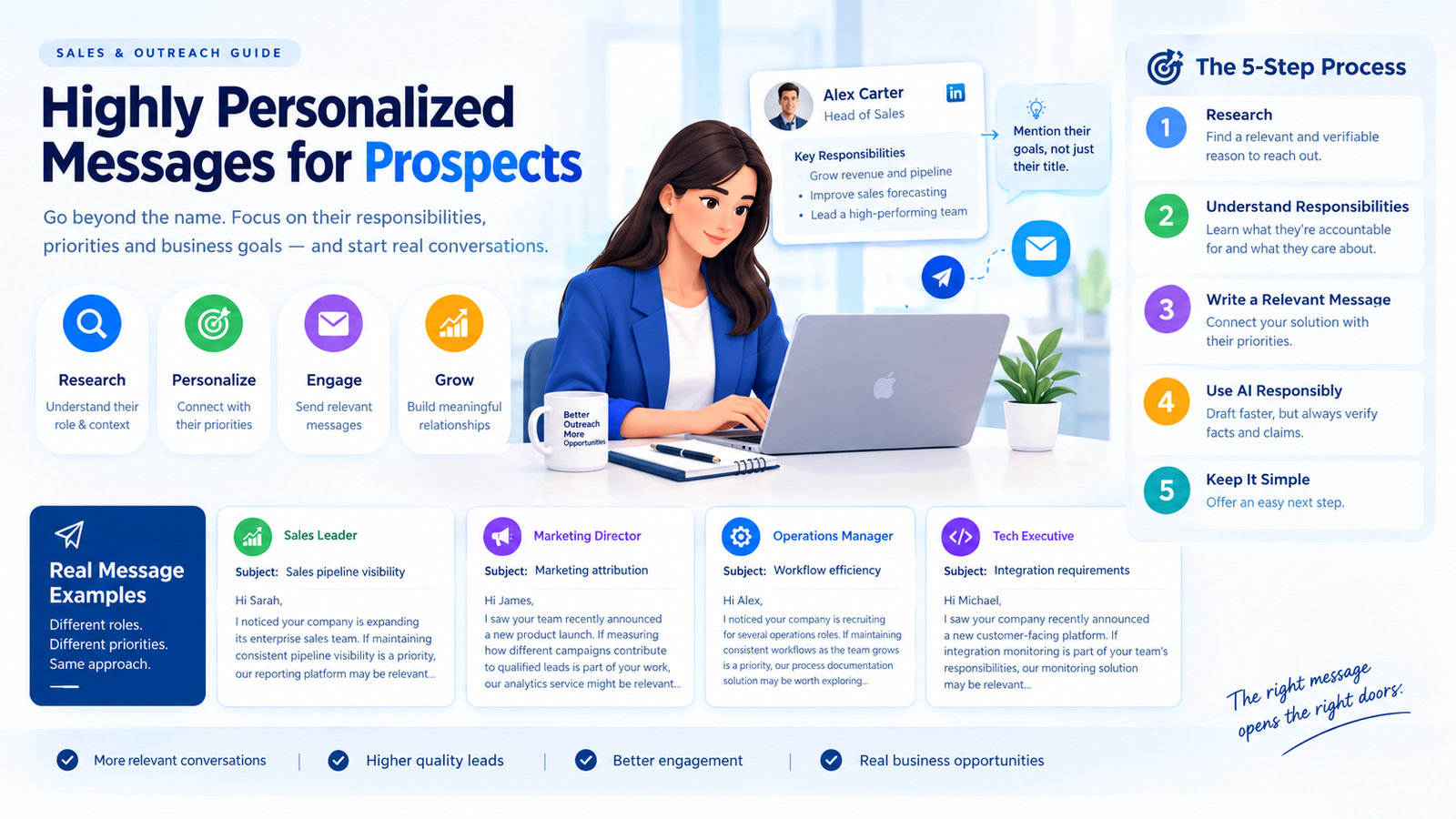
A highly personalized message for a prospect based on responsibilities focuses on what a person is accountable for at work, the outcomes they need to achieve, and the business challenges relevant to their role. Instead of simply using a prospect’s name or mentioning their company, this approach connects the outreach message with a specific professional priority.
For example, a Chief Financial Officer (CFO) may be interested in improving financial visibility, while a Head of Sales may focus on pipeline performance and revenue forecasting. A technology executive might prioritize system reliability, security, or integration requirements. Understanding these differences helps businesses create more relevant messages that feel like the beginning of a professional conversation rather than another generic sales pitch.
In this guide, you will learn how to research prospects, identify their responsibilities, write personalized messages, use AI responsibly, and apply practical templates for email and LinkedIn outreach.
What Is a Highly Personalized Message for a Prospect Based on Responsibilities?

A highly personalized message for a prospect based on responsibilities is a professional communication tailored to the recipient’s actual work, likely priorities, and business context. Its purpose is to explain why a particular product, service, idea, or conversation could be relevant to that person.
Traditional personalization often involves adding a first name, company name, or job title to a prepared template. Although these details can make a message feel less generic, they do not necessarily explain why the recipient should care.
Responsibility-based personalization goes further by connecting the message with something meaningful about the prospect’s professional role.
For instance, a company selling customer relationship management software might approach a sales leader with a message about pipeline visibility. The same company could contact a RevOps manager about data consistency and reporting workflows. Both messages promote the same general solution, but each emphasizes a different professional concern.
The important distinction is that role-based knowledge provides a starting point, not proof of an individual’s priorities. Effective outreach combines that knowledge with verified information about the person or organization.
| 🔗 You may also like: |
| Target Company URL Research |
| Research Dossier for Target Company |
Why Responsibility-Based Personalization Matters
Business professionals receive messages from vendors, consultants, agencies, and service providers competing for their attention. When a message contains only a generic introduction and a product description, the recipient may have little reason to continue reading.
Responsibility-based personalization makes the business relevance clearer. It helps the recipient understand why the sender chose them, how the subject relates to their work, and what value the conversation might offer.
This approach can also improve the quality of sales conversations. When outreach addresses a relevant business objective, the prospect can more easily determine whether the proposed solution deserves further consideration.
However, personalization cannot compensate for poor targeting, an unsuitable offer, or incorrect contact information. Even a carefully written message may receive no response if the recipient has no relevant need or the timing is inappropriate.
The objective is not to guarantee replies. It is to make each message more relevant, credible, and useful.
Understand What the Prospect Is Responsible For
Before writing a message, identify the responsibilities that matter most to the recipient’s position. A job title alone rarely provides enough information to understand the full scope of someone’s work.
For example, a Marketing Director at a small company might oversee content, paid advertising, lead generation, and brand strategy. At a larger organization, the same title could involve managing a single marketing function with support from several specialized teams.
Start by examining the prospect’s professional profile, official company biography, job description, published interviews, or public statements. Company announcements and recruitment pages can also provide clues about current initiatives and organizational priorities.
Match Professional Roles With Relevant Priorities
The following examples illustrate how different responsibilities can influence outreach. They are starting points for research, not assumptions about every person holding a particular title.
| Prospect’s role | Possible priorities | Relevant message angle |
| Chief Financial Officer | Cash flow, margins, financial visibility | Improving cost predictability |
| VP of Sales | Revenue, pipeline quality, forecasting | Increasing visibility across sales opportunities |
| Chief Marketing Officer | Customer acquisition, campaign performance | Improving marketing attribution |
| Head of Customer Success | Retention, adoption, renewals | Identifying customer risks earlier |
| Operations Manager | Workflow efficiency, consistency | Reducing repetitive administrative tasks |
| CTO or VP of Engineering | Reliability, security, scalability | Simplifying technical operations |
| Head of RevOps | CRM data quality, reporting, handoffs | Improving data consistency |
| HR Director | Recruitment, onboarding, employee retention | Making onboarding processes more consistent |
| Procurement Manager | Supplier costs, contracts, vendor risk | Improving supplier visibility |
| Customer Support Manager | Response times, service quality, ticket volume | Streamlining support workflows |
Use this table to decide what to investigate, not what to claim. A prospect’s actual priorities may differ because of their industry, company size, reporting structure, or current projects.
Research Prospects Before Writing
Good personalization starts with relevant research rather than a collection of personal details. The goal is to find a credible reason for contacting the prospect at the present time.
Useful research sources include:
- Company websites: Leadership biographies, product pages, official announcements, and strategic initiatives.
- Professional profiles: Current responsibilities, career history, published posts, and professional interests.
- Job descriptions: Hiring requirements can reveal the capabilities or workflows a department is developing.
- Company reports: Public companies may discuss operational priorities, investments, and business risks in official reports.
- Interviews and presentations: Executives sometimes explain their objectives, challenges, and plans in their own words.
- Recent business developments: Expansion, product launches, partnerships, or organizational changes may provide a relevant conversation starter.
Choose information that supports your reason for reaching out. A recent company announcement is useful only when it connects naturally with your offering.
For example, a business expanding into new markets could be a relevant prospect for a localization provider. The same announcement may have little connection with an unrelated software product.
| 🔗 You may also like: |
| Magazineluiza Com Br Email Format |
| SEO by Highsoftware99 Com |
How to Write a Highly Personalized Message for a Prospect
A practical message can follow a simple structure:
Verified observation → Professional relevance → Value proposition → Supporting evidence → Low-friction call to action
Each part serves a different purpose.
1. Start With a Specific Observation
Open with a relevant professional detail instead of generic praise.
Weak opening: “I love what your company is doing and wanted to introduce our services.”
Stronger opening: “I saw that your company recently announced plans to expand its enterprise sales team.”
The second opening provides a concrete reason for the conversation. Make sure the announcement is accurate and genuinely relevant.
2. Connect the Observation With a Responsibility
Explain why the development might matter to the recipient’s work. Avoid claiming that the person has a particular problem unless you have evidence.
For example, expanding a sales team can introduce additional coordination and reporting requirements. However, you should not automatically assume that the company’s existing reporting process is inadequate.
A more appropriate transition would be: “If maintaining consistent pipeline visibility is becoming more important as the team grows, I thought this might be relevant.”
3. Explain Your Value Clearly
Describe one benefit that connects with the recipient’s responsibilities. Avoid turning the message into a long list of product features.
If you provide reporting software, explain how it supports reporting visibility. If you offer recruitment services, describe the hiring process you help improve.
Keep the proposition accurate and avoid promising results you cannot substantiate.
4. Include Credible Evidence
When available, use a relevant case study, verified customer result, or practical example. Evidence should support the value proposition rather than distract from it.
If you do not have a suitable case study, explain what your service does without inventing statistics or customer success claims.
5. Finish With a Simple Next Step
Instead of immediately requesting a lengthy meeting, offer something easy to evaluate, such as a short example, a relevant resource, or a brief explanation.
A low-pressure question allows the recipient to decide whether further discussion would be useful.
Highly Personalized Message Examples for Different Roles
The following examples demonstrate how to adapt the same general approach to different responsibilities. Replace the illustrative details with verified information and capabilities that accurately describe your own offer.
Example 1: Message for a Sales Leader
Subject: Sales pipeline visibility
Hi Sarah,
I noticed your company is expanding its enterprise sales team. If maintaining consistent pipeline visibility across a growing team is part of your priorities, our reporting platform may be relevant.
It helps teams bring sales activity and opportunity data into a more consistent reporting view. Would a short example of the reporting workflow be useful?
Best,
[Ethan Parker]
Why it works: The message connects a company development with a plausible sales responsibility and offers a specific next step without assuming the prospect has a problem.
Example 2: Message for a Marketing Director
Subject: Marketing attribution
Hi James,
I saw your team recently announced a new product launch. If measuring how different campaigns contribute to qualified leads is part of your current work, I thought our analytics service might be relevant.
We help marketing teams organize campaign performance data to support clearer reporting. Would you be open to receiving a brief overview?
Best,
[Ethan Parker]
Why it works: The opening establishes business context, while the value proposition focuses on a potential marketing priority.
Example 3: Message for an Operations Manager
Subject: Workflow efficiency
Hi Alex,
I noticed your company is recruiting for several operations roles. If maintaining consistent workflows as the team grows is becoming a priority, our process documentation solution may be worth exploring.
It helps teams organize procedures and make operational guidance easier to access. Would a short example be helpful?
Best,
[Ethan Parker]
Why it works: The message connects hiring activity with a possible operational consideration without asserting that the company is experiencing inefficiency.
Example 4: Message for a Technology Executive
Subject: Integration requirements
Hi Michael,
I saw your company recently announced a new customer-facing platform. If integration monitoring is part of your team’s responsibilities around the rollout, our monitoring solution may be relevant.
I can share a brief overview of the capabilities and integration requirements if that would be useful.
Best,
[Ethan Parker]
Why it works: The message focuses on a technical consideration and avoids assuming that the recipient’s systems are unreliable.
How to Personalize LinkedIn Messages and Cold Emails
Different channels require different levels of detail, but the principle remains the same: establish relevance quickly and respect the recipient’s time.
Cold Email
Email provides room for a short observation, a relevant business connection, and a clear next step. Keep the message focused on one subject rather than explaining your entire product.
A practical starting point is approximately 75–125 words, although the appropriate length depends on the complexity of the offer and the recipient’s context. This is a writing guideline, not a guaranteed performance formula.
LinkedIn Outreach
LinkedIn messages often work best when they sound conversational and establish a genuine professional reason to connect.
For example:
“Hi Emma, I noticed your team is developing its customer success function. I work with businesses looking to make customer onboarding workflows more consistent. Would you be open to connecting?”
Avoid sending a lengthy product pitch in the initial connection request. If the person engages, use the conversation to understand whether your offer is relevant.
Follow-Up Messages
A follow-up should contribute something new. You might share a relevant example, clarify the original proposition, or explain a different benefit connected with the recipient’s responsibilities.
Avoid repeatedly sending messages that simply ask whether someone has seen your previous email. Respect objections, opt-out requests, and reasonable communication boundaries.
| 🔗 You may also like: |
| Target Company URL Research |
| Research Dossier for Target Company |
Use AI to Personalize Prospect Messages Responsibly
AI can help sales teams organize prospect research, summarize public company information, identify possible role-related themes, and prepare message drafts. It can also generate different versions of a message for different departments or seniority levels.
However, AI-generated personalization requires verification. A system may confuse people with similar names, use outdated job information, misinterpret an announcement, or invent a connection between a company development and a prospect’s responsibilities.
A practical workflow combines automation with human judgment:
- Collect relevant, appropriate professional information.
- Ask AI to summarize verified facts and identify possible message angles.
- Separate confirmed information from assumptions.
- Draft the message around one relevant responsibility.
- Verify important details and product claims.
- Edit the language to ensure it sounds natural and accurate.
AI should help accelerate preparation rather than replace the research and judgment needed to create credible outreach.
How to Scale Responsibility-Based Personalization
Personalizing every message from scratch can become difficult when a team contacts hundreds of prospects. The solution is to standardize the research process without making every message identical.
Start by grouping prospects according to their roles, industries, company characteristics, and potential use cases. Develop role-specific frameworks that explain which responsibilities may be relevant and which information should be verified.
Next, create reusable message structures with space for individual observations. The framework can remain consistent while the opening, relevant benefit, evidence, and call to action change according to the prospect.
For example, a sales team might use one framework for sales executives and another for operations managers. Each framework can guide the writer toward suitable topics without assuming that everyone in a segment shares the same priorities.
AI and sales tools can support research, draft preparation, and record management. Human review remains particularly important for strategic accounts, uncertain information, and claims involving measurable results.
The goal is to make thoughtful personalization more efficient, not to disguise mass messaging as individual research.
Common Mistakes to Avoid
Even well-intentioned outreach can lose credibility when personalization is handled poorly.
Assuming every person with the same title has identical priorities: Use role-based knowledge as a research guide and verify individual context wherever possible.
Mentioning irrelevant company news: A detail should explain why you are contacting the prospect, not merely prove that you searched their profile.
Making unsupported claims: Do not invent customer results, statistics, internal problems, or responsibilities.
Writing a personalized introduction followed by a generic pitch: Connect the value proposition with the context established in the opening.
Including too much research: One meaningful observation is often more effective than a paragraph of unrelated details.
Using AI without checking the output: Confirm names, roles, company developments, and product capabilities before sending.
Making the call to action too demanding: Give the prospect a reasonable next step that matches the stage of the relationship.
Following up excessively: Additional messages should provide value and respect the recipient’s preferences.
Privacy and Compliance Considerations
Personalized outreach should use professional information responsibly. Publicly available information is not automatically appropriate for every purpose, particularly when it includes sensitive or unrelated personal details.
Organizations should also understand the marketing and data-protection requirements that apply to their campaigns. For example, the United States Federal Trade Commission explains that the CAN-SPAM Act applies to commercial email, including business-to-business messages, and addresses accurate sender information, non-deceptive subject lines, postal address disclosures, and opt-out requirements.
Read the FTC’s CAN-SPAM compliance guide for the applicable US requirements. Other jurisdictions may impose different or additional obligations, so businesses should assess the rules relevant to their sender, recipient, and communication method.
Responsible personalization should remain accurate, proportionate, transparent, and respectful of communication preferences.
How to Measure the Success of Personalized Outreach
The number of messages sent does not show whether personalization is working. Teams should evaluate whether their communication creates relevant conversations and useful business opportunities.
Consider tracking the following indicators:
- Positive reply rate: The proportion of recipients who express genuine interest.
- Qualified conversations: Responses that indicate a relevant need, suitable use case, or potential fit.
- Meeting conversion: The proportion of outreach recipients who progress to a meeting.
- Opportunity creation: The number of conversations that develop into credible sales opportunities.
- Conversion outcomes: The extent to which qualified opportunities progress toward the intended business result.
- Performance by role segment: Which responsibility-based angles produce the most relevant responses.
Compare similar prospect groups and review the results over time. A message that attracts many replies may still perform poorly if the conversations are unqualified.
Use these findings to refine targeting, research methods, message relevance, and follow-up practices.
Best Practices for Responsibility-Based Prospecting
To create stronger messages consistently, follow these principles:
- Research before writing. Find a credible professional reason for contacting the person.
- Focus on responsibilities, not titles alone. Understand what the recipient may be accountable for.
- Use verified context. Distinguish documented facts from reasonable possibilities.
- Choose one meaningful angle. Avoid overwhelming the reader with unrelated information.
- Connect value with the role. Explain the benefit that matters most to the particular conversation.
- Support claims with evidence. Use genuine examples and measurable results only when verified.
- Keep the message concise. Remove unnecessary introductions, jargon, and product descriptions.
- Use AI carefully. Verify its research and review the final draft.
- Make the next step easy. Offer a useful resource or a simple, relevant question.
- Measure conversation quality. Evaluate positive responses and qualified opportunities, not activity alone.
Final Thoughts
A highly personalized message for a prospect based on responsibilities is built around professional relevance rather than superficial familiarity. It shows that the sender understands enough about the recipient’s work to explain why a conversation could be useful.
The process starts with research, continues through a clear value proposition, and ends with a reasonable next step. Every important detail should be accurate, every assumption should be handled carefully, and every claim should reflect what the sender can genuinely support.
AI can make prospect research and drafting more efficient, but it cannot remove the need for verification, sound judgment, and responsible communication.
Ultimately, the strongest outreach answers three questions: Why this person? Why could this matter to their work? Why is this conversation worth having now?
When those answers are clear, personalized prospecting becomes more than a sales technique. It becomes a practical way to build relevant professional relationships.
FAQs
What Is a Highly Personalized Message for a Prospect Based on Responsibilities?
It is a professional message tailored to a prospect’s work, responsibilities, and relevant business context. Instead of relying only on a name or job title, it explains why a particular offer or conversation may be relevant to that person’s professional priorities.
How Do You Personalize a Message Based on Responsibilities?
Research the prospect’s current role and company, identify a relevant and verifiable business signal, and connect it with a genuine benefit your solution can provide. Finish with a simple call to action, and present unverified challenges as possibilities rather than established facts.
What Should You Research Before Contacting a Prospect?
Review professional profiles, official company announcements, job descriptions, interviews, company reports, and relevant public professional content. Prioritize information that directly supports your reason for reaching out instead of collecting unrelated personal details.
How Long Should a Personalized Prospecting Message Be?
There is no universal ideal length. A concise message of approximately 75–125 words can be a useful starting point for many cold emails, provided it establishes context, explains relevance, and offers a clear next step without unnecessary detail.
Can AI Write Personalized Prospect Messages?
Yes. AI can summarize research, suggest role-related angles, prepare drafts, and improve clarity. However, people should verify factual claims, current responsibilities, company developments, and product capabilities before sending AI-assisted messages.