

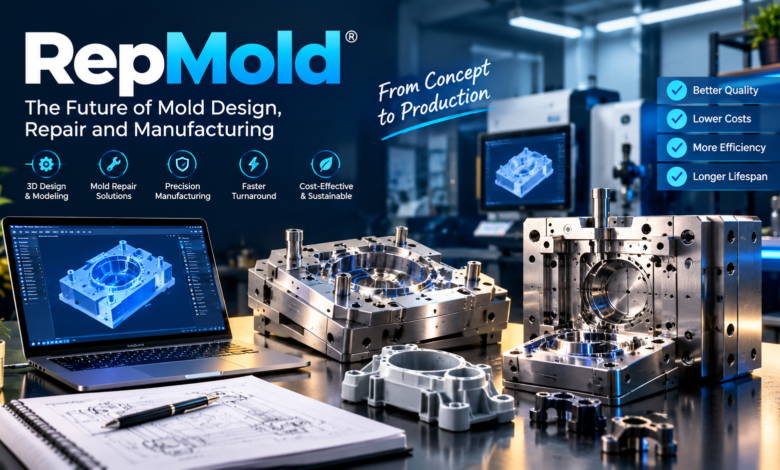
RepMold is a term increasingly used online to describe approaches to mold replication, digital tooling, and modern manufacturing. It is associated with technologies such as computer-aided design (CAD), 3D scanning, 3D printing, CNC machining, and rapid prototyping. These established methods help manufacturers reproduce components, develop molds, refine product designs, and improve production workflows.
The key idea behind RepMold is straightforward: use accurate measurements, digital design, and suitable manufacturing techniques to create or reproduce molds and components more efficiently. Instead of relying entirely on manual measurements and repeated physical adjustments, manufacturers can use digital models to guide design, tooling, and inspection.
However, RepMold does not have one universally accepted technical definition. Different online sources use the term in different ways, so it is important to distinguish the general concept from established manufacturing processes. Understanding the technologies behind it provides a clearer picture of how modern mold replication works and where it can be useful.
What Is RepMold?
RepMold is generally described as an approach to creating, reproducing, modifying, or repairing molds and related components. Depending on the project, the process may involve an existing physical part, an older mold, a digital design, or a newly developed product.
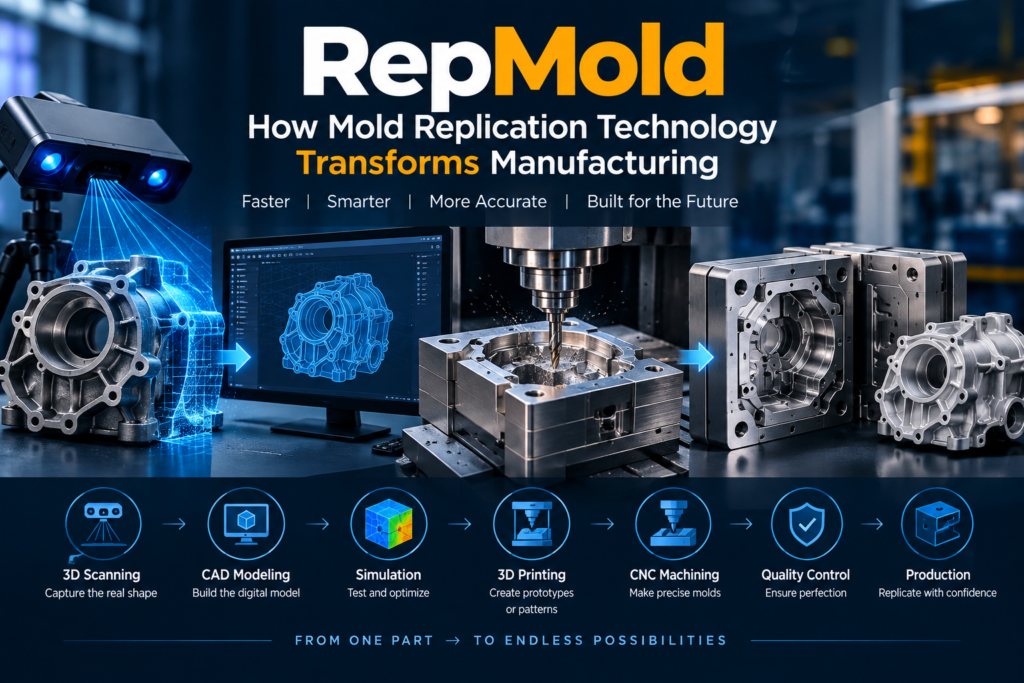
The workflow can combine several manufacturing technologies. For example, an engineer might scan an existing component, reconstruct its geometry in CAD software, manufacture a replacement tool, and inspect the finished result against the approved design.
The specific steps depend on the component, material, required accuracy, production quantity, and intended application. A simple prototype may need only basic measurements and a printed pattern, while a complex industrial mold may require precision machining, engineering analysis, and extensive testing.
It is therefore more accurate to understand RepMold as an informal term associated with digital mold development and replication rather than one specific machine or standardized production method.
🔗 You may also like: Best Wireless Earbuds Under $200 in 2024
How RepMold Technology Works
A RepMold-style workflow generally follows a series of engineering and manufacturing steps. Not every project uses every stage, but the process usually begins with understanding the component and ends with inspection and validation.
1. Inspect the Original Component
The first step is to examine the original part, mold, or product design. Engineers identify its dimensions, surface condition, material, functional requirements, and areas that may need improvement.
This inspection is particularly important when an existing component is being reproduced. A worn part may contain dimensional changes that should not be copied into the replacement.
The intended production environment also matters. A mold designed for a few prototype parts may require different materials and tolerances from one expected to withstand thousands of production cycles.
2. Capture the Geometry
Once the requirements are understood, the manufacturer needs an accurate representation of the component.
This can be created using conventional measurement tools, coordinate measuring equipment, optical inspection, or 3D scanning. The most appropriate method depends on the component’s size, complexity, surface characteristics, and required precision.
Three-dimensional scanning is especially useful for complex curves and irregular surfaces. It can capture a large amount of geometric information that would otherwise require numerous individual measurements.
However, the scan must be checked carefully. Reflective surfaces, inaccessible areas, missing data, and surface damage can affect the quality of the digital representation.
3. Reconstruct the Digital Model
The captured information is processed using CAD software and, where necessary, reverse-engineering techniques.
The objective is to create a usable digital model that accurately represents the intended component. This may involve correcting scanning errors, rebuilding surfaces, checking dimensions, and adjusting features for manufacturing.
Engineers can also make approved design improvements at this stage. For example, they might modify a feature that causes assembly difficulties or adjust the design to suit a different material.
The final model should be reviewed before manufacturing begins because errors in the digital design can carry through to the physical mold.
4. Prepare the Mold Design
A product model is not necessarily ready to become a mold. Additional engineering work may be required to make the tooling practical.
For injection molding, this can include designing the parting line, gates, runners, vents, cooling channels, ejector systems, and draft angles. Engineers may also account for material shrinkage during cooling.
These features influence how the material enters the mold, how heat is removed, and how the finished part is released.
The exact requirements depend on the molding process. Silicone casting, compression molding, and injection molding, for example, do not use identical tooling arrangements.
5. Manufacture the Mold or Tool
After the design has been approved, the mold can be produced using a suitable manufacturing method.
CNC machining removes material from a workpiece according to programmed toolpaths. It is commonly used to produce accurate tooling from metals such as aluminum and steel.
Additive manufacturing, commonly known as 3D printing, builds objects layer by layer. Depending on the technology and material, it can be used to create patterns, prototypes, mold inserts, and certain types of tooling.
Some projects combine both methods. A printed component may provide a basic shape, while machining produces critical dimensions or surface finishes.
6. Test and Inspect the Result
The final stage involves checking whether the mold meets its engineering requirements.
Dimensional inspection can compare the manufactured tool with the approved digital model. Depending on the application, manufacturers may use gauges, optical systems, coordinate measuring machines, or other inspection equipment.
Sample production is also important. A mold that appears correct during inspection may still produce defects under actual operating conditions.
Testing can reveal issues involving fit, material flow, surface finish, shrinkage, cooling, or part removal. The manufacturer can then make adjustments before proceeding to larger production runs.
The Role of 3D Scanning and CAD in RepMold
Three-dimensional scanning and CAD modeling are important technologies in digital mold replication because they connect the physical object with a reusable digital design.
Scanning helps capture the shape of an existing component. CAD software then allows engineers to organize that information, inspect dimensions, reconstruct surfaces, and prepare the model for manufacturing.
This combination is especially valuable when original engineering drawings are unavailable. It can also support the reproduction of discontinued components or the redesign of parts that need modification.
Nevertheless, a scan is not automatically a complete engineering model. The captured geometry may contain noise, gaps, or damage, and it may not reveal internal structures or material properties.
Engineering judgment remains essential. The digital model must represent the intended design and satisfy the functional requirements of the finished component.
RepMold and 3D Printing
Three-dimensional printing can make mold development more flexible, particularly during prototyping and low-volume production.
Traditional metal tooling can require substantial design and machining work. When a product is still being developed, producing permanent tooling for every design revision may be inefficient.
A printed prototype or suitable temporary tool can help a team evaluate dimensions, assembly, appearance, and basic performance before investing in production tooling.
For example, a small manufacturer developing a custom plastic enclosure might print a prototype to verify that the parts fit together. After resolving design issues, the manufacturer can move to a more durable mold suited to the expected production volume.
However, printed tooling has limitations. Temperature resistance, mechanical strength, surface finish, dimensional stability, and expected tool life must all be considered.
🔗 You may also like: DigitalRGS Everything Apple
A printed mold that works for a short trial may not be appropriate for repeated production under high heat and pressure. The correct choice depends on the application rather than on whether the technology is newer.
CNC Machining and Precision Tooling
CNC machining remains an important option when mold accuracy, durability, and surface quality are priorities.
Once the digital design is ready, computer-controlled equipment can manufacture the required geometry from an appropriate material. Different cutting tools and machining operations are selected according to the shape, tolerances, and finish requirements.
Aluminum can be useful for certain prototype and lower-volume tools because it is relatively easy to machine. Steel may be more appropriate when greater wear resistance or a longer production life is required.
The choice should consider the entire manufacturing process, including machining time, finishing, maintenance, and expected production quantity.
Combining digital reconstruction with CNC machining can also help reproduce an older tool when the original design files are missing. The physical mold or component provides a reference, while the digital model guides the replacement.
Applications of RepMold in Modern Manufacturing
The technologies associated with RepMold can support a range of manufacturing activities. Their usefulness depends on the requirements of each industry and the process selected.
Automotive and Industrial Engineering
Automotive manufacturers use molds and tooling to produce interior components, housings, panels, and numerous other parts.
Digital reconstruction can support prototype development, replacement tooling, and the reproduction of components when original design files are unavailable.
Industrial engineering companies may use similar methods to reproduce specialized fittings, machine components, fixtures, and tooling inserts.
Product Development and Prototyping
Product designers often need to test multiple versions before finalizing a design.
Digital models make it easier to modify dimensions and evaluate alternatives without rebuilding the entire design from the beginning. Prototypes can then help confirm whether the proposed changes work as intended.
This approach can be particularly useful for new products, customized designs, and projects in which requirements are still evolving.
Replacement and Legacy Parts
Older equipment may contain components for which original molds or manufacturing drawings no longer exist.
In such situations, engineers can inspect the surviving part, capture its geometry, reconstruct the design, and produce replacement tooling where appropriate.
The challenge is distinguishing the original intended geometry from wear, deformation, and previous repairs. A replacement should restore the required function rather than reproduce every defect in the old component.
Consumer Products and Packaging
Molded components are common in household products, packaging, personal-care items, toys, and consumer electronics.
Testing a design and its tooling before full production can help identify dimensional or manufacturing problems early.
For high-volume products, however, the cost of tooling must be evaluated against production speed, durability, maintenance, and the number of parts expected over the mold’s lifetime.
Medical and Specialized Equipment
Digital mold development can also support prototypes, equipment housings, laboratory components, and certain customized products.
Medical applications require additional care. Materials, manufacturing conditions, traceability, testing, and applicable regulatory requirements must be considered before a product is used in a clinical setting.
Digital manufacturing alone does not establish that a component is safe or suitable for medical use.
Key Benefits of a RepMold-Style Workflow
When the selected technologies match the project requirements, digital mold replication can offer several practical advantages.
Faster design changes: Engineers can update a digital model before manufacturing a replacement tool. This is useful when a design is still being refined.
Reusable digital records: Approved models can be stored for later manufacturing, repair, or modification, reducing the need to repeat the entire measurement process.
Improved repeatability: A controlled digital model can provide a consistent reference for producing additional tools or components, provided that manufacturing and inspection are properly managed.
Earlier problem detection: Design reviews and suitable simulations can identify some potential issues before physical tooling is completed.
Greater flexibility: Manufacturers can select among machining, printing, casting, and hybrid methods according to the project’s requirements.
Potential cost savings: Faster prototyping or less expensive tooling may reduce development costs in suitable applications. Savings are not guaranteed, since equipment, software, finishing, inspection, and maintenance all contribute to total cost.
The main advantage is the ability to connect design information with manufacturing decisions. The value comes from choosing and managing the process correctly, not simply from using digital technology.
Challenges and Limitations
RepMold-style methods are not suitable for every component or production requirement.
Material and Tool Durability
A temporary polymer tool may not withstand the same temperatures, pressures, or repeated cycles as a hardened steel mold. Material selection must reflect the actual manufacturing environment.
Accuracy and Surface Finish
Scanning errors, imperfect CAD reconstruction, machining limitations, and printed-layer characteristics can affect the final result. Some molds require additional polishing, machining, coating, or finishing.
Cost and Production Volume
Digital tools can reduce costs for certain prototypes and small production runs, but specialized equipment and engineering work can be expensive.
For a stable design that will be manufactured in very large quantities, conventional production tooling may provide better long-term value.
Engineering Validation
Simulation can help predict material flow, heat transfer, or other process behavior, but its results depend on the quality of the input data and assumptions.
Physical samples and production trials remain important for confirming that a mold performs as expected.
Intellectual Property and File Security
Digital design files can contain confidential product information. Businesses should control access, maintain revision histories, and use secure methods to share files with suppliers.
They should also ensure that they have the necessary rights to reproduce a component or use its design.
How to Choose the Right Mold Replication Method
Before selecting a process, manufacturers should evaluate the project as a whole rather than focusing only on the initial tooling price.
Important questions include:
- What material will the final component use?
- How many parts must be produced?
- What dimensional tolerances are required?
- Will the mold face high temperatures or pressures?
- How long must the tooling last?
- What surface finish is acceptable?
- Are original CAD files available?
- What inspection and testing are necessary?
A prototype may be suitable for 3D printing, while a more demanding production application may require CNC-machined metal tooling. A hybrid approach may be appropriate when the project needs both geometric flexibility and precision finishing.
The best option is the one that meets the engineering requirements at an acceptable total cost.
The Future of Digital Mold Replication
Digital manufacturing continues to connect product design, tooling, inspection, and production data more closely.
Improvements in scanning, CAD software, additive manufacturing, and automated inspection may make some replication workflows more accessible. Simulation tools can also help engineers evaluate design alternatives before physical tooling is produced.
Artificial intelligence may support selected tasks, such as identifying geometric features, assisting with design optimization, or analyzing inspection data. The practical value of these applications will depend on their accuracy, integration, and validation.
Digital records may also make it easier to reproduce older components when replacement parts are needed. Securely stored design files, manufacturing instructions, and inspection results can provide a useful reference for future work.
These developments are part of the broader evolution of digital manufacturing. They should not be interpreted as verified features of a single RepMold machine or software platform.
Is RepMold Right for Every Manufacturing Project?
No. The appropriate approach depends on the component, material, budget, accuracy requirements, production volume, and expected tool life.
Digital replication can be useful when a company needs to reproduce an existing component, develop a prototype, modify tooling, or manufacture a limited number of parts.
Traditional tooling may remain the better choice for stable, high-volume production where long service life and repeatable performance are essential.
A sensible evaluation compares the full cost and performance of each option, including engineering, tooling, finishing, inspection, maintenance, and possible design changes.
The name of the workflow matters less than the actual methods used and the evidence that they meet the required specifications.
Final Thoughts
RepMold is best understood as a broad, inconsistently defined term associated with mold replication and digitally supported manufacturing. The practical technologies behind the concept include CAD modeling, 3D scanning, reverse engineering, 3D printing, CNC machining, and quality inspection.
These methods can help manufacturers develop prototypes, reproduce components, maintain digital design records, and select more flexible tooling strategies. Their effectiveness depends on suitable materials, accurate engineering, controlled manufacturing, and appropriate testing.
Ultimately, successful mold replication is not simply about copying a physical shape. It is about understanding the component’s purpose, creating a reliable design, choosing the right production method, and verifying that the finished tool performs as required.
FAQs
What does RepMold mean?
RepMold is an informal term commonly associated with mold replication, digital tooling, and modern mold development. Its exact meaning varies across online sources, and it does not have one universally accepted technical definition.
Is RepMold a specific machine or software?
The available information does not establish one universally recognized RepMold machine or software platform. The term is often used to describe a broader approach involving established manufacturing technologies.
Does RepMold always require 3D printing?
No. A project may use 3D printing, CNC machining, casting, conventional measurement, 3D scanning, or a combination of these methods. The appropriate process depends on the design and production requirements.
Is digital mold replication cheaper than traditional tooling?
It can be less expensive for certain prototypes, repairs, and short production runs. For high-volume production, durable conventional tooling may offer better long-term value. A meaningful comparison should include the full lifecycle cost.
Can an old component be reproduced without its original CAD file?
Often, yes. Engineers can measure or scan an existing component and reconstruct a digital model. The result must be checked carefully because wear, damage, and hidden features may not be captured accurately.
What is the difference between RepMold and injection molding?
Injection molding is an established manufacturing process in which material is injected into a mold to form a part. RepMold is an informal term associated with creating, reproducing, or modifying molds and related components. The two terms do not describe the same thing.