
Statens Luftfartsvæsen Explained: Denmark’s Aviation Authority, History, and 2010 Merger

Statens Luftfartsvæsen (SLV) was Denmark’s former civil aviation administration, responsible for regulating and supporting the safe operation of civil aviation. For decades, it played an important role in aviation safety, technical standards, air traffic services, and airport operations within the Kingdom of Denmark.
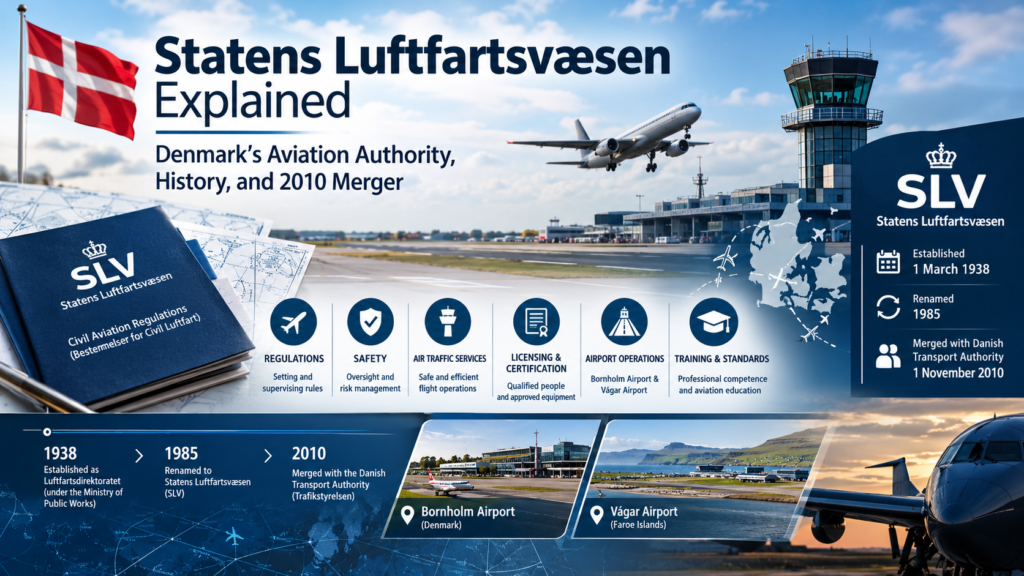
Established on 1 March 1938 as Luftfartsdirektoratet, the agency developed alongside the aviation industry and adapted to changing transport needs. Its name changed to Statens Luftfartsvæsen in 1985, reflecting its established role in Danish aviation administration.
The organization ceased to exist as a separate agency on 1 November 2010, when it merged with the Danish Transport Authority. Although its original name disappeared, its regulatory responsibilities continued under the successor administration.
Understanding Statens Luftfartsvæsen provides useful insight into Denmark’s aviation history, the development of civil aviation regulation, and the institutional changes that shaped the country’s modern transport system.
What Was Statens Luftfartsvæsen?
Statens Luftfartsvæsen was a Danish government body responsible for important aspects of civil aviation regulation and aviation services. Its Danish name is commonly abbreviated to SLV, while English-language references describe it as the Civil Aviation Administration Denmark.
The agency operated under the Danish transport administration and worked to ensure that aviation activities followed applicable safety requirements and operating rules. Its responsibilities covered several connected areas, including aviation regulation, technical oversight, air traffic services, and airport operations.
SLV was not simply an airport management organization. Its work involved establishing requirements, supervising compliance, and supporting the systems needed for safe and orderly aviation.
The administration also had operational responsibilities at particular airports, including Bornholm Airport and Vágar Airport in the Faroe Islands. This combination of regulatory and operational duties made it a distinctive part of Denmark’s aviation system.
| 🔗 You may also like: |
|---|
| DigitalRGS: Everything Apple |
| Best Wireless Earbuds Under $200 |
Quick Facts About Statens Luftfartsvæsen
| Detail | Information |
|---|---|
| Official Danish name | Statens Luftfartsvæsen |
| Common abbreviation | SLV |
| English name | Civil Aviation Administration Denmark |
| Established | 1 March 1938 |
| Original name | Luftfartsdirektoratet |
| Renamed | 1985 |
| Government affiliation | Danish transport administration |
| Main field | Civil aviation regulation and services |
| Notable airport responsibilities | Bornholm Airport and Vágar Airport |
| Merger date | 1 November 2010 |
| Successor at the time | Danish Transport Authority (Trafikstyrelsen) |
These details summarize the agency’s historical identity. Its current responsibilities should be understood through the Danish authorities that succeeded it, rather than by treating SLV as an active independent organization.
The History of Statens Luftfartsvæsen
Establishment in 1938
Statens Luftfartsvæsen traces its institutional origins to 1 March 1938, when Denmark established Luftfartsdirektoratet under the Ministry of Public Works.
At the time, aviation was developing into a more practical form of transportation. Aircraft design, commercial flight operations, and airport infrastructure were advancing, creating a greater need for consistent government oversight.
A dedicated aviation administration helped provide a formal framework for managing these developments. Instead of treating aviation as a collection of separate activities, the government could coordinate regulatory requirements and technical responsibilities through a specialized organization.
The agency’s establishment marked an important stage in the development of Danish civil aviation administration.
The Name Change in 1985
In 1985, Luftfartsdirektoratet became known as Statens Luftfartsvæsen. The new name became closely associated with Denmark’s public aviation administration.
By this period, civil aviation had become an established part of international transportation. Airlines, airports, maintenance organizations, pilots, and air traffic services all depended on technical rules and regulatory oversight.
The administration’s work therefore extended beyond the basic regulation of aircraft. It also involved maintaining aviation requirements, supervising relevant organizations, and supporting the systems needed to manage flights safely.
Aviation Regulation Before 2010
During the decades leading up to its merger, SLV operated within a regulatory environment increasingly influenced by international aviation standards and European cooperation.
Civil aviation authorities must coordinate national requirements with wider international frameworks. Aircraft may cross borders, airlines may operate internationally, and aviation professionals often work under recognized licensing and certification systems.
Denmark’s aviation administration needed to address these interconnected requirements while maintaining national oversight.
One of its important regulatory functions was publishing Civil Aviation Regulations, known as Bestemmelser for Civil Luftfart (BL). These rules covered subjects such as aircraft and equipment, aerodromes, aviation activities, training, airways, safety systems, and commercial flight operations.
Such regulations provided practical requirements for organizations and professionals working within the Danish aviation system.
The 2010 Merger
The most significant institutional change in SLV’s history occurred on 1 November 2010. On that date, Statens Luftfartsvæsen merged with the Danish Transport Authority, Trafikstyrelsen, and ceased to operate under its former name.
The change brought aviation administration into a broader transport authority rather than maintaining SLV as a separate organization.
The merger represented an administrative reorganization, not the end of Denmark’s civil aviation regulation. Aviation safety, regulatory supervision, and related functions continued through the successor authority.
For historical research, the distinction is important: Statens Luftfartsvæsen is the name of the former agency, while Trafikstyrelsen is associated with the continuation of its functions after the merger.
| 🔗 You may also like: |
|---|
| Global Trader Programme |
| Sosoactive Explained |
Main Responsibilities of Statens Luftfartsvæsen
SLV’s responsibilities included both regulatory work and aviation services. Its functions can be understood through several major areas.
1. Civil Aviation Regulations
One of the administration’s central responsibilities was developing and publishing Civil Aviation Regulations.
These rules established requirements for different parts of aviation, helping airlines, pilots, airport operators, maintenance organizations, and training providers understand the standards applicable to their activities.
Regulations could address aircraft equipment, airworthiness, aerodrome operations, aviation training, air routes, and commercial flight services.
For example, an aviation organization needed to understand the applicable technical and operational requirements before carrying out a regulated activity. Clear rules helped provide a common framework for compliance and oversight.
The publication of regulations also made the authority’s requirements accessible to the aviation sector.
2. Aviation Safety and Technical Oversight
Safety oversight was another important part of SLV’s work. Civil aviation depends on the interaction of aircraft design, maintenance, pilot qualifications, operating procedures, airport infrastructure, and technical systems.
Aviation regulators establish and supervise requirements intended to manage risks across these areas.
SLV’s responsibilities included safety standards and the supervision of compliance. Depending on the activity, this could involve reviewing documentation, assessing whether regulatory requirements had been met, and overseeing relevant aviation organizations.
Technical oversight is essential because aviation safety cannot depend solely on the actions of individual pilots or airlines. It also requires appropriate systems, qualified personnel, maintained equipment, and clear operational rules.
3. Air Traffic Control and Air Traffic Services
SLV’s responsibilities also included an air traffic control and services function.
Air traffic services help aircraft navigate safely and efficiently. They support the orderly movement of flights, provide relevant information to pilots, and help manage interactions between aircraft in controlled airspace.
This work depends on trained personnel, communication systems, operational procedures, and technical infrastructure.
The administration’s structure included a distinction between the civil aviation regulatory function and the air traffic control service function. The former focused on standards and compliance, while the latter provided air traffic services and dealt with associated technical systems.
This distinction illustrates the different kinds of expertise required to regulate aviation and deliver its operational services.
4. Licensing and Certification
Civil aviation requires qualified professionals and appropriately approved equipment and facilities. Licensing and certification provide formal ways to demonstrate that applicable requirements have been met.
SLV’s regulatory responsibilities included areas associated with aviation personnel, aircraft, and operational facilities.
Depending on the relevant rules, licensing and certification can cover matters such as pilot qualifications, aircraft airworthiness, maintenance activities, and airport operating requirements.
These processes help establish clear expectations for aviation professionals and organizations. They also give the regulator a framework for checking compliance with technical and operational standards.
It is important, however, not to assume that every certificate or licence was issued directly by the same organizational unit. Regulatory responsibilities and the practical administration of individual approvals can differ.
5. Airport Operations
SLV had a notable connection to airport operations, including direct responsibility for operating Bornholm Airport and Vágar Airport in the Faroe Islands.
Airport operations involve coordinating runway and airside activities, maintaining appropriate facilities, following operational procedures, and supporting the safe movement of aircraft.
An airport must also work with airlines, ground service providers, aviation authorities, and other relevant organizations.
The administration’s operational involvement at these airports is a useful part of its history. It demonstrates that its role extended beyond writing regulations and supervising external operators.
Bornholm Airport serves the Danish island of Bornholm, while Vágar Airport is an important aviation gateway for the Faroe Islands. Their inclusion in SLV’s historical responsibilities reflects the importance of air transport to communities outside mainland Denmark.
6. Training and Aviation Standards
Aviation training and professional competence are closely connected to safety. Pilots, technical personnel, and other aviation professionals must meet the qualifications required for their particular roles.
SLV’s regulatory framework addressed aviation training and related standards. Such requirements helped define the conditions under which aviation professionals could qualify for regulated activities.
Training standards are especially important in a technical industry where personnel must understand equipment, procedures, safety requirements, and emergency responsibilities.
The agency’s work in this area formed part of the wider system governing civil aviation in Denmark.
How Was Statens Luftfartsvæsen Organized?
SLV combined different aviation functions within one public administration. A useful way to understand its organization is to distinguish between regulation and operational services.
The Civil Aviation Regulatory Function
The regulatory side was responsible for setting safety requirements and supervising compliance. This involved the rules and oversight applicable to aviation organizations, technical activities, and operational standards.
Its purpose was to ensure that regulated activities met the requirements established by the relevant authorities.
The Air Traffic Control Service
The air traffic control function dealt with air traffic services and associated technical systems. Its work supported the safe and orderly movement of aircraft.
Although regulation and air traffic services serve related objectives, they are not identical functions. One focuses on standards and oversight, while the other involves the delivery of operational services.
Government and Transport Administration
SLV operated within Denmark’s government transport structure. Its institutional position connected aviation regulation with the wider administration of national transport policy.
This arrangement provided a public framework for aviation oversight and allowed the administration to operate within the government’s broader transport responsibilities.
What Happened to Statens Luftfartsvæsen After 2010?
Following the merger on 1 November 2010, the Danish Transport Authority became the institutional successor responsible for continuing the relevant aviation functions.
The former SLV name was discontinued, but civil aviation regulation continued as part of Denmark’s public transport administration.
Over time, the organization and naming of Danish transport authorities have changed. For that reason, historical references to SLV should not automatically be treated as descriptions of the current authority’s exact structure or name.
Readers seeking current information about aviation regulations, pilot licensing, airport requirements, or aircraft approvals should consult the official Danish transport authority website.
Official resource: Danish Civil Aviation and Railway Authority (Trafikstyrelsen).
This is particularly important for people who need current rules rather than historical background.
Why Statens Luftfartsvæsen Still Matters
Although SLV no longer exists as a separate agency, its history remains relevant for several reasons.
First, it helps explain how Denmark developed a formal system for regulating civil aviation. The agency’s evolution reflects the growing technical and administrative demands of air transport.
Second, its regulatory work provides historical context for the rules governing aviation organizations. Civil Aviation Regulations helped define requirements for aircraft, airports, training, and other activities.
Third, the 2010 merger illustrates how governments reorganize public institutions without necessarily ending the functions those institutions perform.
Finally, SLV’s responsibilities at Bornholm and Vágar airports highlight the importance of regional aviation. Airports outside major metropolitan areas can be essential for transport access, economic activity, and connections between geographically separated communities.
Understanding the former administration therefore helps explain both the history of Danish aviation and the development of its modern regulatory framework.
| 🔗 You may also like: |
|---|
| Voozon Explained |
| Target Company URL Research |
Conclusion
Statens Luftfartsvæsen played an important role in the development of Denmark’s civil aviation administration. From its origins as Luftfartsdirektoratet in 1938 to its renaming in 1985, it helped establish and supervise the regulatory framework governing aviation activities.
Its responsibilities included civil aviation regulations, safety oversight, air traffic services, licensing-related functions, and airport operations. Its work also extended to important regional aviation facilities, including Bornholm Airport and Vágar Airport.
The merger with Trafikstyrelsen on 1 November 2010 ended SLV’s independent institutional existence, but it did not end Denmark’s responsibility for civil aviation regulation. Its history remains a useful reference for understanding how aviation oversight developed and how the functions of a former government agency continued within a broader transport authority.
FAQs
What does Statens Luftfartsvæsen mean?
Statens Luftfartsvæsen is the Danish name of Denmark’s former Civil Aviation Administration. It is commonly abbreviated as SLV and was responsible for civil aviation regulation and related services.
When was Statens Luftfartsvæsen established?
Its institutional origins date to 1 March 1938, when it was established as Luftfartsdirektoratet under the Ministry of Public Works. The name Statens Luftfartsvæsen was adopted in 1985.
Why did Statens Luftfartsvæsen disappear?
The agency merged with the Danish Transport Authority, Trafikstyrelsen, on 1 November 2010. Following the merger, the former name was discontinued and its relevant responsibilities continued within the successor administration.
Which airports did SLV operate?
Historical accounts identify Bornholm Airport in Denmark and Vágar Airport in the Faroe Islands among the airports operated by the administration.
What were Civil Aviation Regulations (BL)?
They were Danish civil aviation rules covering various subjects, including aircraft, equipment, aerodromes, training, airways, safety systems, and commercial aviation activities.
Does Statens Luftfartsvæsen still exist?
No. It ceased to exist as a separate agency in 2010. People looking for current Danish aviation requirements should consult the official Danish transport authority.