

Colors are an essential part of everyday life, influencing how people experience art, photography, websites, advertisements, and interior spaces. Some colors create a sense of warmth and energy, while others appear cool, refreshing, or calming. Cyan is one of the most recognizable colors in the blue-green family, known for its bright appearance and widespread use in digital design, printing, and visual communication. The term Cyanová has also appeared in online discussions about the meaning and applications of this distinctive color.
Understanding Cyanová requires looking at its connection to cyan, its possible linguistic background, and the technical systems used to represent colors. HEX, RGB, and CMYK values help designers describe colors precisely, while color theory explains how different shades interact in a composition. These concepts are useful for anyone working with websites, digital artwork, photography, branding, or printed materials.
Although Cyanová is commonly described online as a cyan or blue-green color, it does not have one universally established HEX code or official technical specification. Its precise appearance depends on how the term is being used. This guide explores its meaning, the established properties of cyan, common color values, and practical ways to use cyan-inspired shades in creative projects.
What Is Cyanová?
Cyanová is a term associated with cyan, a vivid color positioned between blue and green. Cyan is widely recognized in digital graphics, printing, photography, and design. Depending on its shade and surrounding colors, it can appear bright and energetic or soft and refreshing.
The word Cyanová may also reflect a linguistic form associated with cyan in certain Slavic languages, including Czech and Slovak. The exact meaning and grammatical use depend on the language and context in which it appears. Therefore, it is important not to assume that every appearance of Cyanová refers to a distinct pigment or a standardized color.
In modern design discussions, the term is useful as a starting point for exploring blue-green colors and their applications. A designer might use a cyan-inspired shade to highlight a website element, create a technology-themed illustration, develop a brand identity, or introduce a fresh accent into a photograph.
However, the name alone does not guarantee a specific visual result. Two websites may describe different shades as Cyanová while displaying different colors. When accuracy matters, the best approach is to identify the actual color sample or numerical value associated with the term.
Understanding the Cyan Color Family
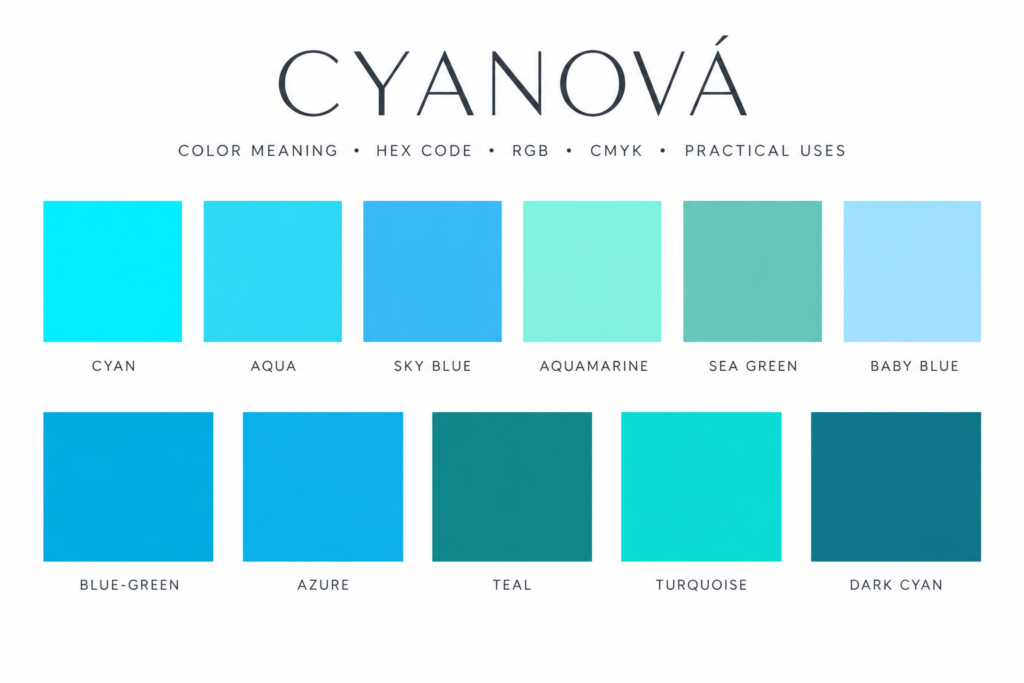
The cyan color family includes several related shades, such as aqua, turquoise, teal, and lighter blue-green variations. Although these colors can look similar, differences in hue, brightness, and saturation give each one a distinctive appearance.
Cyan is often associated with a bright mixture of blue and green. In the standard RGB color model, pure cyan is produced by combining maximum green and blue light without red light. This makes it especially noticeable on digital screens.
Aqua is another name for the same color as CSS cyan. Turquoise generally has a softer, more varied blue-green appearance, while teal is usually darker and more subdued. Pale cyan shades contain more white or have lower saturation, creating a lighter and less intense visual effect.
These distinctions matter because choosing the right shade can change the entire mood of a design. A bright cyan accent may look modern and energetic, whereas a muted blue-green background can create a more relaxed atmosphere.
Cyanová may be used informally for a color within this family. Since the term does not identify one universally fixed shade, designers should verify its intended appearance before applying it to projects that require consistent colors.
| 🔗 You may also like: |
| Fontlu: Design, Typography & Font Resource Guide |
| Bodenxt Green Industrial Transformation: Sustainable Tech |
Cyanová HEX Code, RGB, and CMYK Values
Color codes allow designers to reproduce and communicate colors across different applications. HEX and RGB are commonly used for digital displays, while CMYK is primarily associated with printing.
If Cyanová is intended to represent pure digital cyan, the following values provide a useful reference.
| Color format | Pure cyan reference |
| HEX | #00FFFF |
| RGB | 0, 255, 255 |
| HSL | 180°, 100%, 50% |
| CMYK | 100%, 0%, 0%, 0% as a basic reference |
| CSS color name | cyan or aqua |
These values describe pure cyan, not an officially standardized Cyanová shade. A specific color sample may require different values.
HEX Code: #00FFFF
A HEX code is a six-character color notation commonly used in website development, digital illustrations, and graphic design. It represents the red, green, and blue components of a color using hexadecimal values.
The code #00FFFF represents pure cyan. The first pair, 00, indicates the absence of red, while FF represents the maximum value for both green and blue in the standard eight-bit system.
Designers can apply this code to website backgrounds, icons, interface elements, presentations, and digital artwork. If a particular reference uses a darker or greener shade of Cyanová, its actual HEX code should be used instead.
RGB Value: 0, 255, 255
RGB stands for red, green, and blue. It is the color model used by most digital screens, including laptops, smartphones, televisions, and desktop monitors.
Each channel in the standard eight-bit RGB model can have a value from 0 to 255. Pure cyan uses no red and maximum green and blue, producing the familiar bright blue-green appearance.
Changing these channel values creates different shades. Lower values produce darker colors, while adjustments to the balance between green and blue can shift the appearance toward greener or bluer tones.
This flexibility makes RGB useful for digital design, where a particular Cyanová-inspired shade can be adjusted to suit a website, illustration, or user interface.
CMYK Value: 100%, 0%, 0%, 0%
CMYK stands for cyan, magenta, yellow, and key, which generally refers to black. This model is used in many commercial printing processes.
A basic cyan reference uses 100% cyan, with no magenta, yellow, or black. However, this does not guarantee that printed cyan will look identical to #00FFFF on a screen.
Screens produce light, while printed materials reflect light from ink and paper. The available inks, paper type, printing equipment, and color profile can all affect the final result.
For professional projects, designers should use the printer’s recommended color settings and review a physical proof before approving large print runs.
The Meaning and Psychology of Cyanová
Colors can influence the atmosphere of a design and the way people interpret visual information. Cyan and similar blue-green shades are often associated with freshness, clarity, water, and modern technology. These associations can make them useful in creative projects, although individual reactions vary according to culture, experience, and context.
Freshness and Cleanliness
Cyan is frequently used in visuals connected with water, cleanliness, and freshness. Its blue-green appearance can create a clean and open visual impression, particularly when combined with white or light gray.
Designers may use lighter cyan shades for wellness graphics, product packaging, educational materials, and websites that benefit from a fresh appearance. The surrounding design elements should support the same message for the overall effect to feel consistent.
Technology and Innovation
Bright cyan is common in technology-inspired designs because it stands out against darker backgrounds. It can be used for digital illustrations, software interfaces, futuristic graphics, and presentation slides.
When paired with navy or charcoal, cyan can create a noticeable contrast without requiring multiple bright colors. Using it selectively also helps guide attention toward important elements.
Calmness and Visual Balance
Softer blue-green shades may create a more relaxed appearance than highly saturated cyan. They can work well in backgrounds, decorative elements, and designs intended to feel simple and approachable.
However, a color does not automatically create a particular emotional response. Brightness, contrast, typography, and the surrounding environment all influence how the final design is perceived.
Practical Uses of Cyanová

Cyan-inspired shades can be used in several industries and creative fields. Their suitability depends on the exact shade, the audience, and the purpose of the project.
1. Website and User Interface Design
In website development, cyan can be used for buttons, icons, navigation highlights, links, and other interactive elements. It can help separate important controls from surrounding content when the contrast is appropriate.
For example, a website with a dark navy background might use bright cyan for selected navigation items and action buttons. A lighter website might use pale cyan panels with dark text to maintain a clean appearance.
Designers should avoid applying bright cyan to every element because excessive saturation can make a page feel crowded. A limited palette usually creates a clearer visual hierarchy.
2. Branding and Logo Design
Cyan-inspired colors can help establish a distinctive visual identity. Technology businesses, creative agencies, and digital publications may use blue-green shades to develop a modern appearance.
A logo that combines cyan with navy can look professional and structured, while cyan paired with orange may feel more energetic and creative. The best combination depends on the brand’s message and intended audience.
Consistency is essential. Once a particular shade has been selected, its numerical values should be documented so that websites, business cards, social media graphics, and other materials use the same color.
3. Photography and Digital Art
Cyan can be useful in photo editing, digital illustration, and visual effects. Photographers sometimes adjust blue-green tones to create a cooler atmosphere or emphasize water, skies, reflections, and shadows.
Digital artists can use cyan for glowing details, abstract backgrounds, futuristic environments, and dramatic lighting effects. It can also contrast with warmer colors to make selected objects more noticeable.
The amount of cyan matters. Strong color adjustments may distort natural skin tones or remove detail from an image, so subtle changes are often more effective when realism is important.
4. Printing and Publishing
Cyan is one of the four process colors used in CMYK printing. It contributes to the reproduction of photographs, illustrations, advertisements, and other full-color materials.
Cyan-inspired shades can appear in magazines, brochures, posters, business cards, and product packaging. However, digital and printed colors may differ because screens produce light while printed surfaces reflect it.
Paper type, ink, printing equipment, and color profiles all influence the final appearance. A physical proof is especially useful when a specific shade is important to a brand or publication.
5. Interior Decoration
Blue-green shades can be introduced into interior spaces through wall accents, furniture, artwork, cushions, curtains, and decorative accessories.
A light cyan may complement white walls and natural wood, creating a bright and open appearance. Darker teal-like shades can provide a stronger focal point in a living room, office, or creative workspace.
Pure digital cyan is highly saturated and may look intense when used across large surfaces. For interior decoration, softer variations are often easier to incorporate into a balanced color scheme.
6. Product Packaging
Packaging designers use colors to distinguish products and create recognizable visual identities. Cyan-inspired shades can be suitable for electronics, stationery, creative products, and various consumer goods.
A successful design needs more than an attractive color. Typography, readability, product information, material, and brand consistency are also important.
Before approving a large production run, designers should review a physical sample. A color that appears bright on a calibrated monitor may look different when printed on cardboard, plastic, or coated paper.
Best Color Combinations for Cyanová
The colors surrounding cyan can significantly affect its appearance. Neutral shades often provide balance, while warmer colors create stronger contrast.
| Color | HEX code | Suggested application |
| White | #FFFFFF | Clean backgrounds and minimal designs |
| Navy | #000080 | Professional branding and technology interfaces |
| Charcoal | #36454F | Modern layouts and readable text |
| Orange | #FF8C00 | Creative accents and energetic graphics |
| Coral | #FF7F50 | Illustrations and expressive branding |
| Light gray | #F2F2F2 | Backgrounds and content sections |
| Black | #000000 | High-contrast visual elements |
For a professional website, cyan and navy can establish a strong visual hierarchy. For a creative project, cyan and orange can provide a noticeable contrast between cool and warm tones. White and light gray can create a simpler, more restrained appearance.
These combinations are starting points rather than fixed rules. Always check the contrast between text and its background, particularly when designing buttons, menus, and small interface labels.
Cyanová vs. Cyan, Aqua, Turquoise, and Teal
Cyanová is associated with cyan, but several other color names are commonly used for similar blue-green shades.
Cyan: A bright blue-green color. Pure digital cyan is represented by #00FFFF.
Aqua: In CSS, aqua and cyan are equivalent named colors and use the same HEX value, #00FFFF.
Turquoise: A related blue-green shade represented by #40E0D0 in CSS. It generally appears different from pure cyan.
Teal: A darker blue-green color represented by #008080 in CSS. It can provide a more subdued alternative to bright cyan.
Cyanová itself does not have one universally established technical color value. As a result, its precise relationship to these shades depends on how the term is being used.
When exact color matching matters, numerical specifications are more reliable than names alone.
Tips for Using Cyanová Effectively
A few practical principles can help designers use cyan-inspired shades more successfully.
- Select a specific shade: Choose a HEX or RGB value for digital work rather than relying solely on the name Cyanová.
- Use bright colors selectively: Reserve highly saturated cyan for important accents when a calmer overall design is needed.
- Check accessibility: Ensure that text and interactive elements have sufficient contrast against their backgrounds.
- Maintain consistency: Record approved color values for logos, websites, graphics, and printed materials.
- Test the final output: Review designs across different screens and request print proofs when color accuracy is important.
- Consider the surrounding palette: Evaluate the entire composition rather than judging a shade in isolation.
These practices help reduce inconsistencies and make the final result more useful, readable, and visually balanced.
Conclusion
Cyanová is a color-related term associated with cyan and the wider blue-green color family. It provides a useful starting point for exploring color theory, digital design, photography, branding, printing, and interior decoration.
Pure digital cyan has a standard HEX value of #00FFFF and an RGB value of 0, 255, 255. A basic CMYK reference is 100%, 0%, 0%, 0%, although these values do not guarantee an identical appearance across screens and printed materials.
The important distinction is that Cyanová does not have one universally recognized HEX, RGB, or CMYK specification. Its exact appearance depends on the intended shade and how the term is being used.
FAQs
What does Cyanová mean?
Cyanová is a term associated with cyan and blue-green colors. It also has a linguistic connection with Czech and Slovak adjective forms, where its meaning depends on grammatical context.
What is the HEX code for Cyanová?
There is no universally standardized HEX code for Cyanová. If the intended color is pure digital cyan, the standard reference is #00FFFF.
What is the RGB value of Cyanová?
Pure cyan has an RGB value of 0, 255, 255. A custom Cyanová-inspired shade may use different values.
What is the CMYK value of Cyanová?
A basic reference for cyan is 100%, 0%, 0%, 0% in CMYK. Actual printed results depend on the printing equipment, inks, paper, and color profile.
Is Cyanová the same as turquoise?
Not necessarily. Turquoise is a related blue-green shade, but its appearance and numerical color values differ from pure cyan. Cyanová does not have one fixed technical specification of its own.
Can Cyanová be used in website design?
Yes. Cyan-inspired colors can be used for buttons, icons, backgrounds, illustrations, and branding. Designers should consider contrast, readability, and the overall visual hierarchy.
Why does Cyanová look different on different screens?
Screen calibration, brightness, display technology, color profiles, and surrounding lighting can affect how a color appears. Different screens may reproduce the same numerical color value differently.
Is Cyanová suitable for printing?
Cyan-related colors are used in commercial printing, but screen colors do not always reproduce identically on paper. Appropriate color profiles and physical proofs help improve consistency.