
Data privacy has become an important part of modern business strategy. As organizations collect customer information through websites, mobile applications, marketing platforms, and digital services, they need reliable ways to manage consent, respect individual preferences, and maintain transparent data practices. These responsibilities have increased demand for privacy technology that can operate across complex business environments.
Syrenis operates in this growing market through its Cassie consent and preference management platform. The company focuses on helping organizations manage customer permissions and preferences across digital interactions, supporting more consistent privacy processes and customer communication.
The main themes behind Syrenis strategic initiatives include enterprise platform development, global business growth, technology integration, customer trust, and evolving privacy requirements. Its leadership developments and partnership announcements also provide insight into its business direction. Understanding these priorities helps explain how Syrenis fits into the wider privacy technology industry and why its services may matter to organizations managing customer data at scale.
What Are Syrenis Strategic Initiatives?
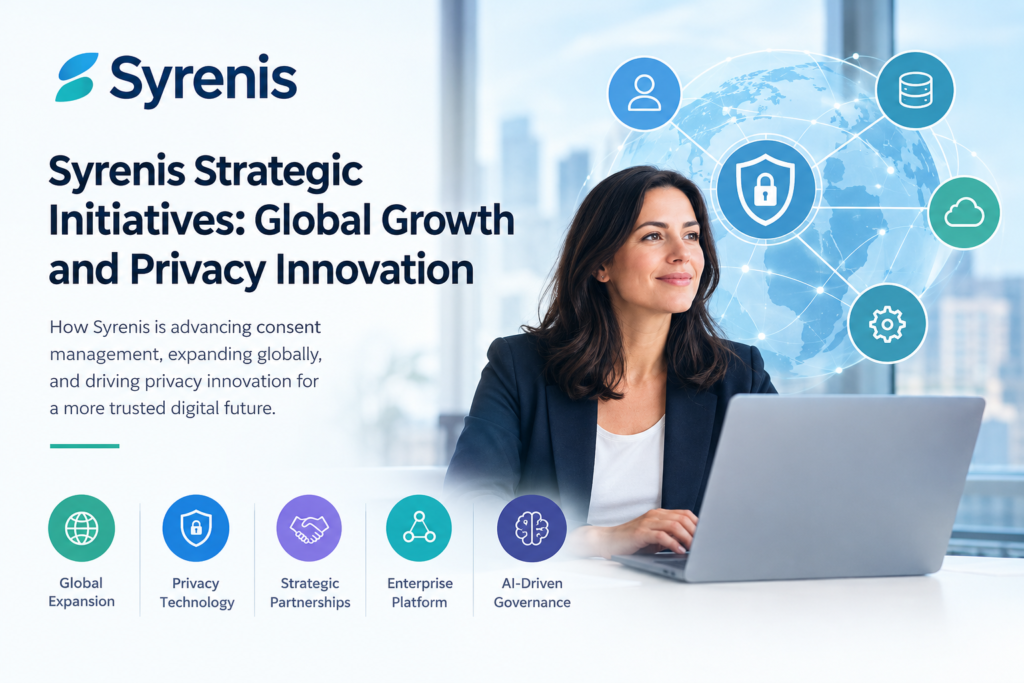
Syrenis strategic initiatives refer to the business priorities, product development efforts, and growth activities associated with the company’s enterprise privacy technology offering. These priorities reflect the need to help organizations manage customer consent and communication preferences while adapting to changing business and regulatory environments.
Its Cassie platform is central to this approach. Rather than treating consent as a one-time decision, consent and preference management involves recording choices, updating them when customers change their minds, and making relevant information available to connected business systems.
For example, an online retailer might have customers who agree to receive order confirmations but decline promotional emails. The business needs to distinguish essential service communications from marketing preferences and ensure its systems reflect the customer’s decisions.
A structured privacy management platform can help organize these records and reduce inconsistencies. Syrenis addresses this operational challenge through technology designed for organizations with complex customer data requirements.
It is important to distinguish these established business priorities from proposed future plans. Individual expansion targets, product launches, and artificial intelligence features should be considered confirmed only when supported by reliable company announcements or current product documentation.
| You may also like: |
|---|
| Global Trader Programme |
| Growth Navigate Funding |
Understanding Syrenis and Its Cassie Platform
The role of consent and preference management
Consent and preference management helps organizations understand what customers have permitted and how they want to interact with a business. Although closely related, these concepts serve different purposes.
Consent concerns permission for particular data processing activities where consent is the applicable legal basis. Preferences describe choices such as communication channels, marketing frequency, or the types of information a customer wants to receive.
Cassie brings these activities into the wider enterprise privacy management process. Syrenis positions the platform as a solution for managing consent and preferences across customer interactions and connected technologies.
This is particularly relevant to businesses that use multiple marketing, customer relationship management, and analytics systems. When customer choices are stored separately, teams may struggle to maintain consistent records.
A centralized approach can help organizations coordinate these records more effectively. However, its practical value depends on appropriate configuration, accurate data, suitable integrations, and well-defined internal procedures.
Key Syrenis Strategic Initiatives Driving Business Growth
Syrenis’ publicly described business direction combines international expansion with a stronger enterprise market position. Several developments help illustrate how the company is pursuing these priorities.
1. Expanding Into the North American Market
One of the clearest developments in Syrenis strategic initiatives is its expansion into the United States. Adam Binks joined the company’s board in October 2024 and became CEO in February 2025. Under his leadership, Syrenis launched US operations and established a dedicated North American presence to support enterprise customers.
This move places the company closer to organizations seeking consent and preference management solutions across North America. US businesses face a varied privacy landscape that includes California’s privacy legislation and laws enacted in other states, alongside sector-specific requirements.
A local commercial presence can help a technology provider build relationships with enterprise buyers, understand regional requirements, and coordinate customer support. However, success depends on more than opening an office; the company must also demonstrate that its platform meets customer needs across different regulatory and technical environments.
2. Strengthening Enterprise Privacy Technology
Syrenis is positioning itself around the wider requirements of enterprise privacy management rather than treating consent as an isolated website function. Its platform is designed to collect privacy choices, organize consent information, apply governance processes, and synchronize data across connected systems.
This direction reflects the needs of large organizations that operate several brands, websites, customer databases, and marketing channels. A change to one customer’s preferences may need to be reflected in multiple systems to avoid inconsistent communication.
For example, an international retailer might manage several online stores in different countries. A centralized approach can help its teams coordinate customer preferences while accounting for differences in local requirements.
The strategic challenge is making the technology flexible enough to accommodate these environments without creating unnecessary complexity for business users.
3. Building Strategic Partnerships
On August 6, 2025, Syrenis announced a strategic partnership with The Data Privacy Group (DPG). The collaboration combines Syrenis’ Cassie platform with DPG’s privacy programme consulting and implementation expertise, initially targeting clients in the UK, European Union, and North America.
The partnership brings together two complementary capabilities. Software can help organizations record and manage privacy choices, while consultants can help design policies, establish processes, and integrate privacy practices into everyday operations.
Consider a financial services company implementing a new privacy management programme. It may need technology for recording customer permissions as well as expert guidance on internal responsibilities, regulatory obligations, and implementation.
A combined approach can address both sides of this challenge. The partnership demonstrates a practical way Syrenis can broaden the support available to enterprise clients without relying exclusively on software features.
4. Expanding Integrations Across Enterprise Systems
Integration is another important part of Syrenis’ growth strategy. The company currently advertises more than 350 integrations connecting privacy data with CRM, marketing, analytics, and other operational systems. This is a company-reported figure, and the integrations available and appropriate for a particular customer depend on its technical environment.
Connected systems matter because customer choices must be applied wherever relevant information is used. If someone withdraws permission for a particular marketing activity, the appropriate connected systems need to reflect that change.
Without effective integration, organizations may depend on manual updates, duplicated records, or separate departmental processes. These weaknesses can increase administrative work and make it harder to maintain consistent customer experiences.
Syrenis’ focus on integration addresses this practical enterprise requirement. The value of the approach ultimately depends on reliable data flows, correct configuration, and appropriate controls over how information is shared.
| You may also like: |
|---|
| Coyyn: Digital Finance and Innovation |
| Target Company URL Research |
How Syrenis Supports Privacy Compliance and Customer Trust
Privacy compliance is not simply a matter of displaying a cookie banner or collecting a checkbox response. Organizations need to understand why personal information is processed, which rules apply, and how individual choices affect their activities.
Syrenis’ technology supports consent and preference management processes that can contribute to this broader responsibility.
Managing Privacy Requirements Across Jurisdictions
The European Union’s General Data Protection Regulation (GDPR), California’s Consumer Privacy Act as amended by the California Privacy Rights Act (CCPA/CPRA), and other privacy laws create different obligations for organizations handling personal data.
These requirements are not interchangeable. For example, consent is one legal basis for processing under the GDPR, while California’s privacy framework includes specific rights to opt out of certain sales, sharing, and uses of personal information.
A privacy platform can help organizations maintain records, coordinate preferences, and provide evidence of relevant actions. Nevertheless, software does not independently establish legal compliance. Businesses must also maintain appropriate policies, identify applicable legal requirements, and ensure that their actual data practices meet those requirements.
Making Customer Choices Easier to Respect
Customer trust depends partly on whether organizations respect the choices people make. Someone who unsubscribes from promotional emails should not continue receiving the same marketing messages because another system has not been updated.
A consent and preference management platform can help reduce this kind of inconsistency by connecting relevant records across business systems.
The benefits may include clearer communication, fewer avoidable errors, and improved visibility for privacy and marketing teams. These outcomes are not automatic, but they become more achievable when the technology is supported by sound processes and responsible data practices.
Syrenis, Artificial Intelligence, and the Future of Data Governance
Artificial intelligence is creating new questions about how organizations collect, use, and govern personal information. Businesses may use AI to analyze customer interactions, improve services, automate workflows, or personalize digital experiences. Each use case can raise questions about data access, purpose limitation, transparency, and accountability.
Syrenis has highlighted responsible data use, customer trust, and consent management in the context of AI-driven environments as part of its wider industry positioning.
Consent and preference records can help organizations understand which customer choices apply to particular activities. However, they are only one part of responsible AI governance. Organizations may also need data inventories, access controls, impact assessments, human oversight, and procedures for evaluating risks.
It is equally important not to assume that every AI-related privacy challenge can be resolved through consent alone. Depending on the circumstances, organizations may need other lawful bases for processing, additional safeguards, or restrictions on particular uses of personal information.
For Syrenis, the opportunity lies in helping enterprise customers maintain consistent privacy controls as their data environments become more complex. Its future position will depend on how effectively its products evolve alongside customer requirements, emerging regulations, and changes in enterprise technology.
Leadership and Brand Repositioning at Syrenis
Leadership changes have been another visible part of the company’s development. In March 2025, Syrenis announced the appointment of Martin Audcent as Chief Financial Officer and Paul Glynn as Chief Strategy Officer, following Adam Binks’ appointment as CEO. The company presented these developments as part of its efforts to support its next phase of growth.
A further milestone came on April 21, 2026, when Syrenis announced a brand refresh and consolidated its identity under the Syrenis name. The company explained that the refreshed positioning better reflected its enterprise platform and the complexity of the organizations it serves.
This repositioning matters because enterprise buyers often need more than a basic consent tool. They may require technology that accommodates multiple brands, jurisdictions, departments, and interconnected systems.
The refreshed identity supports the company’s effort to communicate that broader proposition to enterprise customers in the United States, the United Kingdom, and Europe.
Challenges That Could Influence Syrenis’ Growth
Despite the opportunities in privacy technology, Syrenis operates in a demanding market. Several factors will influence how effectively it can pursue its strategic objectives.
-
Regulatory complexity: Privacy requirements differ between jurisdictions and continue to evolve, requiring adaptable technology and ongoing expertise.
-
Integration requirements: Large businesses may rely on legacy systems that require careful technical work before customer preference data can be synchronized reliably.
-
Enterprise competition: Privacy technology providers must demonstrate that their solutions offer practical value, dependable performance, and appropriate support.
-
Changing customer expectations: Organizations must balance useful personalization with transparency and meaningful control over personal information.
-
Implementation quality: Even sophisticated software depends on accurate data, appropriate configuration, employee training, and clear internal responsibilities.
These are wider industry challenges rather than evidence of specific weaknesses at Syrenis. The company’s ability to address them will help determine how successfully it can translate its enterprise positioning into lasting customer relationships.
How Businesses Can Evaluate Syrenis
Organizations considering Syrenis should begin by identifying their most important privacy management requirements. The right solution depends on the scale of operations, existing technology, applicable regulations, and the complexity of customer interactions.
A practical evaluation should examine integration compatibility, the accuracy of consent records, the handling of preference changes, auditability, and the level of support available during implementation.
Businesses should also clarify which capabilities are included in their proposed configuration, how updates are propagated across connected systems, and how the platform fits into existing privacy governance procedures.
Syrenis advertises more than 350 integrations, but organizations should verify that the specific connectors and workflows they need are supported.
The objective is not simply to purchase privacy software. It is to establish a dependable process for managing customer choices across the organization.
| You may also like: |
|---|
| BodenXT: Green Industrial Transformation |
| Magazineluiza.com.br Email Format |
Conclusion
Syrenis strategic initiatives reflect a broader shift in enterprise privacy technology: moving from isolated consent collection toward connected, scalable management of customer preferences and data governance.
Its North American expansion, leadership appointments, partnership with The Data Privacy Group, and 2026 brand repositioning provide concrete examples of its business direction. Meanwhile, Cassie and the company’s integration capabilities remain central to its enterprise offering.
As organizations adopt new digital services and explore AI-driven applications, consistent privacy management is likely to remain an important operational requirement. Technology can help businesses respect customer choices, improve recordkeeping, and coordinate privacy processes, although it cannot replace legal expertise or responsible governance.
Syrenis’ long-term progress will depend on how effectively it meets enterprise requirements, develops its platform, and supports customers across increasingly complex data environments.
FAQs
What are Syrenis strategic initiatives?
They are the company’s business priorities around enterprise privacy technology, international expansion, consent and preference management, integration, and customer trust.
What is Cassie?
Cassie is the consent and preference management platform historically associated with Syrenis. In its April 2026 brand refresh, Syrenis consolidated its identity under the Syrenis brand.
Who is the CEO of Syrenis?
Adam Binks was appointed CEO in February 2025 to lead the company’s next phase of growth and international expansion.
What was Syrenis’ partnership with The Data Privacy Group about?
Announced on August 6, 2025, the partnership combined Syrenis’ consent management technology with DPG’s privacy programme consulting and implementation expertise.
How does Syrenis support data privacy compliance?
Its platform helps organizations manage consent, customer preferences, and associated records across connected systems. Organizations remain responsible for determining and meeting their applicable legal obligations.
Why are Syrenis’ strategic initiatives relevant to AI?
AI introduces additional questions about how personal data is accessed and used. Consistent consent records and privacy governance can help organizations manage these issues, alongside other legal, technical, and organizational safeguards.